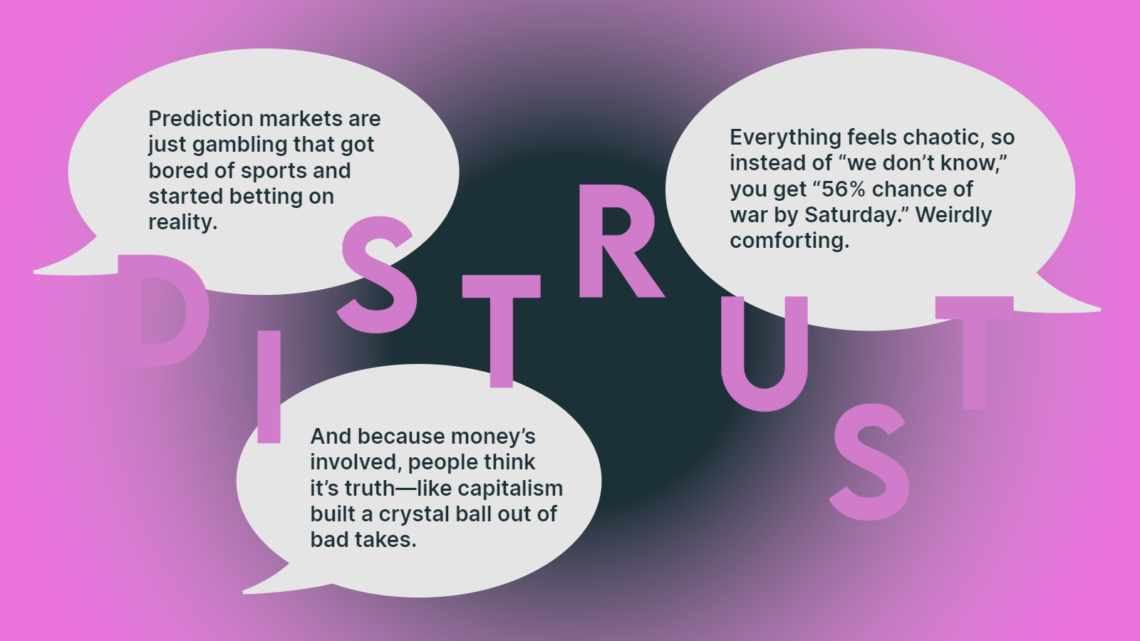
Sense of Uncertainty, Sense of Control, and Sensing the Future: Notes on Prediction Markets
In the early hours of February 28th, the US and Israel carried out air strikes on hundreds of sites across Iran. In the weeks since, I have made several unsuccessful attempts at writing a summary of the war as an introduction to this article. I would write one account of the events in the evening and then wake up to a new state of affairs the next morning (for an overview of the war so far see Ahn, 2026; Gedeon, 2026). First, there was a war to destroy the supposed Iranian nuclear weapons. Then it was regime change. Then it was to open the Hormuz Strait (which, to be clear, was open before the conflict). Then Trump threatened genocide via tweet. Then there was an armistice, except Israel insisted it did not apply to Lebanon. As I write this, US-Iran talks have failed, and Trump has announced his perplexing decision to blockade the Iranian blockade (Yerushalmy, 2026) in a classic “I’m not fired because I quit!” moment. I therefore give up. By the time you read this, the situation will have changed 100 more times. A month from now Iran might blockade the American blockade that was blockading the initial Iranian blockade – who’s to say? The bottom line is that the world today is dominated by a sense of uncertainty.
Foreign policy experts have little to no idea what has motivated the initial strikes (Bush, 2026). Indeed, it seems somewhat unfair to demand a coherent explanation from experts when the Trump administration itself seems to lack a vision of what was meant to happen (Swan & Haberman, 2026). It was widely reported that, while the members of the administration publicly supported Trump’s actions, there was internal conflict about the president’s decision (Swan & Haberman, 2026). Looking at Trump for explanations is even less illuminating considering he switches from praising Allah from one day (Greenall, 2026) to threatening war crimes the next (Wong, 2026). This atmosphere of uncertainty, I argue, is part of the reason for the newfound popularity of so-called “prediction markets”.
Enter Polymarket and Kalshi – two “prediction markets” (read: gambling websites) which have recently gained popularity for allowing users to bet on the outcome of real-world events. The way it works is that you pick a prediction, say “Strait of Hormuz traffic returns to normal by end of April?” and then you buy “stock” into either “yes” or “no” depending on your vast insight into world politics. You may sell your stock early or you may wait for the predetermined end date to be paid out. Current trending markets include bets on when a US-Iran deal might be reached, the outcome of several football games, whether the price of Bitcoin will cross a certain threshold in the next 5 minutes, and, perhaps most famous of all, whether Jesus Christ will return before 2027 (Lyall, 2026).
The immediate explanation for the newfound popularity of such platforms is economical. Casinos and gambling sites are often strictly regulated, illegal or operate in markets saturated with competition. Moreover, their scope is somewhat limited: their total addressable market is limited by the number of games to bet on, and the generally poor perception people have of gambling. To maintain the same growth rates, capital needs to continuously expand. When it becomes limited in one market it creates a new one through commodification or disrupts an existing market (what Harvey (2003) would refer to as accumulation by dispossession). The birth of “prediction markets” is therefore something of natural development: it commodifies a previously unmonetized aspect of life while simultaneously addressing a broader audience. At the same time, it manages to wash off the “dirty” lingo of traditional gambling: people do not place bets, they buy a kind of stock on a platform that rewards expertise rather than luck.
This relates to a second, psychological consideration related to prediction markets. Orgaz et al. (2013) discuss the notion of “illusion of control” whereby pathological gamblers are more prone to believe that they have agency over an uncontrollable outcome of a bet. In conventional gambling, this illusion is a byproduct which can be weaponized by “the house”: games such as roulette or a lottery have players control the numbers they pick, in craps players throw the dice themselves etc. However, in conventional gambling the object of the bet is often partially or wholly tangential: there is no inherent value to a blackjack hand, images of fruit lined up on the screen, or the sum of dice. Exerting control over these outcomes has little value beyond the stake of the bet.
When the object of betting is the outcome of real-world events, the sense of control has value outside of the bet. It may be the case that repeatedly betting on geopolitics might also create an illusion of control. The main attraction of prediction markets is still the potential to win big, however, the sense of control and agency one develops during betting might also be a secondary appeal. Recent international conflicts have been difficult to predict and affect large swaths of the world’s population. In this context, it is not difficult to imagine that the sense of control is also an important part of this sort of gambling. The economic innovation of prediction markets is therefore twofold: it manages to widen the market it addresses in a strict economic sense while also capitalizing on the otherwise tangential illusion of control offered by gambling. This also means that while prediction markets address a new market, it also offers an appeal (even if a mild one) to seasoned gamblers.
A final perspective to consider, is anthropological which, like many other anthropological insights, begins with an account of Balinese cock fighting. Specifically, the work of anthropologist Clifford Geertz (1972), who observed ritualized forms of gambling on cock fights during his fieldwork in Bali. Geertz explains that cockfights are an illustration for the social relationships permeating the community he is in (Geertz, 1972). Men of the village rear and groom cocks whose fighting prowess come to represent the power of the owner (Geertz, 1972). The cock fights therefore represent a simulation of the status fight between real people, and the broader event in which the fights take place are a model for the social world of the village (Geertz, 1972). Ultimately, cockfighting is the “story the Balinese tell themselves about themselves” (Geertz, 1972). Adopting this insight, I want to analyze prediction markets less so as innovative marketing and more so as stories told by the world about itself.
What strikes me about Polymarket is how strangely individualistic and alienating these platforms are. In Geertz’ (1972) work, the cock fight is a central event for the village. Beyond settling and reinforcing the status of participants, it is also a social occasion (Geertz, 1972). Similarly, the betting parlor, the horse track, the casino are all important and quintessentially communal places. Compare that to the decidedly individualistic and digital experience of Polymarket or Kalshi. Public opinion is abstracted into a number going up or down, gambling is done from the comfort of one’s home, while there is a comment function, there is a pervading sense of anonymity and isolation. The prediction market functions to emulsify the geopolitics discussion you might have with your taxi driver or uncle into a discrete monetizable market. Naturally, it is not Polymarket who is stopping you from talking to your taxi driver or uncle, but as the world becomes more individualistic it is plausible prediction markets would absorb more and more of the function of such encounters.
Another way prediction markets differ from more traditional gambling is their use as methods for sensing the future. Take for instance the article by Plummer (2026) published by Newsweek which opens with the following passage:
“The likelihood Viktor Orbán winning [sic] Hungary’s upcoming parliamentary election has dropped since U.S. Vice President JD Vance made a speech endorsing him, according to the latest betting odds.” (para. 1)
The article goes on to describe the evolution of “Orbán’s stock” in the leadup to the Hungarian election with the obvious implication that prediction markets odds can be treated as the odds of a particular election result occurring (Plummer, 2026). Polymarket (n.d.) claims that prediction markets are more accurate than traditional polling because “participants are financially incentivized to be correct” and because of an effect known as “collective intelligence” (whereby a large number of guesses average out to the correct answer).
Whether or not these claims are true is an empirical question I do not have an answer to. I must say that I am very skeptical but then again, I may be paid by Big Opinion Polling. Irrespective of accuracy, this method of prediction outcomes seems emblematic for the world we live in. Prediction market odds bypass any sort of expertise since they are crowdsourced through betting. In this way they are the ultimate symptom of skepticism towards experts who are completely eliminated from the process. They are also very fast to adapt to new realities because, unlike opinion polling, they require no fieldwork and no data analysis. This makes them particularly suitable for a deeply neurotic audience who, looking to make sense of an unstable world, can compulsively check their phones to get a sense of what the future might hold.
To conclude, what does the way we gamble say about us? Realistically, not too much. Polymarket and Kalshi are primarily the symptoms of an unregulated, scam-prone economic system. These platforms have a disproportionately large media presence because of how outrageous their existence is. Still, adopting an analytical lens such as that of Geertz may offer insight into the stories our world tells about itself. Unlike the status battle encapsulated by Balinese cock fighting, today’s gambling is simultaneously isolated yet a method for collective crowdsourced truth. It functions as a monetized fortune telling ritual in which the ultimate geopolitics expert is the dollar. The gambler buys into the illusion of big wins but also into an illusory sense of control over world events. Broadly, for non-gamblers, prediction markets are pitched as the ultimate expert-free, crowd-sourced fortune telling method. These conclusions might seem exaggerated, and, in truth, it may very well be so – still, it is not clear what the future has in store.
References:
Ahn, A. (2026, April 7). Iran War timeline: Key moments and attacks in U.S. and Israel’s campaign. The New York Times. https://www.nytimes.com/2026/04/07/world/middleeast/iran-war-trump-us-israel-oil-strait-of-hormuz.html
Bush, D. (2026, March 2). Trump’s Iran endgame unclear after mixed messaging on war aims. The BBC. https://www.bbc.com/news/articles/cm214xk30vxo
Gedeon, J. (2026, April 4). Oil, strait of Hormuz and empty threats: A timeline of Trump’s flip-flopping on the Iran war. The Guardian. https://www.theguardian.com/us-news/2026/apr/04/timeline-iran-war-trump-contradictions
Geertz, C. (1972). Deep play: Notes on the Balinese cockfight. Daedalus, 101(1), 1–37. https://www.jstor.org/stable/pdf/20024056.pdf
Greenall, R. (2026, April 5). Trump issues expletive-laden threat to Iran over Hormuz Strait blockage. The BBC. https://www.bbc.com/news/articles/cvg0q6wdzp1o
Harvey, D. (2003). The new imperialism. Oxford University Press. https://academic.oup.com/book/40584
Orgaz, C., Estévez, A., & Matute, H. (2013). Pathological gamblers are more vulnerable to the illusion of control in a standard associative learning task. Frontiers in Psychology, 4. https://doi.org/10.3389/fpsyg.2013.00306
Plummer, K. (2026, April 9). Orban’s chances of winning hungary election drop after JD Vance rally. Newsweek. https://www.newsweek.com/viktor-orban-hungary-election-jd-vance-rally-11804123
Polymarket. (n.d.). Polymarket vs. polling. Polymarket.com; Polymarket Help Center. Retrieved April 18, 2026, https://help.polymarket.com/en/articles/13364238-polymarket-vs-polling
Swan, J., & Haberman, M. (2026, April 7). How Trump took the U.S. to war with Iran. Nytimes.com; The New York Times. https://www.nytimes.com/2026/04/07/us/politics/trump-iran-war.html
Wong, E. (2026, April 5). Trump revels in threats to commit war crimes in Iran. The New York Times. https://www.nytimes.com/2026/04/05/us/politics/trump-iran-war-crimes-truth-social.html
Lyall, I. (2026, February 20). The jesus trade and why polymarket’s reality is stranger than fiction. Proactive Investors UK. https://www.proactiveinvestors.co.uk/companies/news/1087680/the-jesus-trade-and-why-polymarket-s-reality-is-stranger-than-fiction-1087680.html
Yerushalmy, J. (2026, April 13). Strait of Hormuz blockade explained: Why is Trump threatening it now and will it increase the price of oil? The Guardian. https://www.theguardian.com/world/2026/apr/13/strait-of-hormuz-blockade-what-why-explained-navy-trump-iran

Iulian Ion is a cultural and social anthropology master’s student at the UvA and he holds a political science bachelor’s degree. His main academic interests are penal policy and the methods of enforcing and subverting authority. Outside his studies he enjoys swimming, reading, and playing video games.

Madelene Nitzsche is a Cultural and Social Anthropology student at the University of Amsterdam with a background in communication studies, interior design, graphic design, and photography. Her experience growing up in Western and non-Western environments has influenced her interest in culture, art, urbanisation, and psychology. Opposing viewpoints, emotion, and contrast are a focus in her artistic work and it is also what drives her interest in the ethnographic approach. She is currently experimenting with multimedia artwork and poetry and perception of reality. Her vision is to integrate art and culture with ecology and community to improve societal relations and the relation to the self. You can follow her process @24yutori.