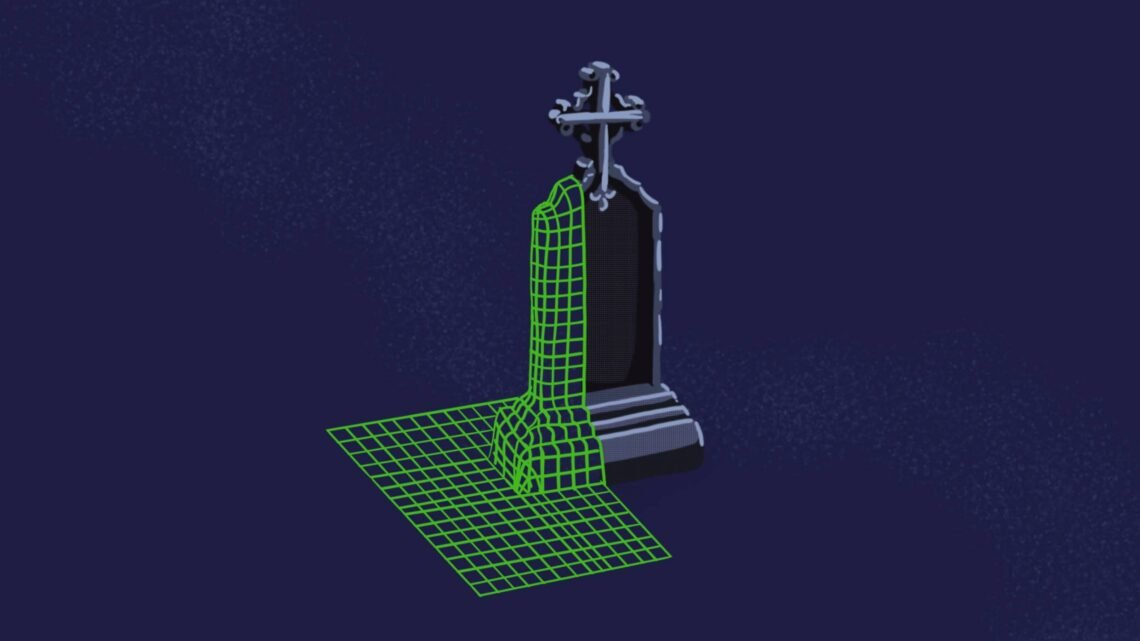
What Happens to Our Digital Self When Our Physical Self Leaves?
Facebook Notification: “It’s Kristina’s birthday today! Say Happy Birthday.”
Yet Kristina isn’t here anymore to see them. To see her ‘Happy 38th’ wishes. The photos, comments, or memories we share on her wall. But her digital presence remains, as a persistent echo of her life, frozen in time but still visible, still inviting interaction.
What happens to our digital self when our physical self is gone? In an era where our lives are woven into social media, emails, playlists, and countless online archives, physical death no longer guarantees an ending. Instead, our online identities often linger, raising questions about memory, grief, control, and what it truly means to say goodbye.
More Than Just My Data
Our digital self is far more than a collection of online materials we leave behind (e.g., messages, photos, social media profiles, emails, playlists, and search histories). These digital traces help tell the story of who we are, or rather, who we were. They extend beyond what is typically remembered by our friends and family.
Unlike traditional memories held in the mind, digital memories exist in a tangible, more persistent form. They can remain accessible long after someone has passed away. In this way, digital presence does not end at the same moment as physical life. Instead, it remains visible and, in some cases, interactive. A photo shared years ago can be liked today, a message thread can be reopened and revisited, and a playlist can continue to play the songs that once defined a person’s tastes.
Through studies on the presence of our “online self”, these digital traces can be seen as extensions of identity rather than neutral data (Alhuzami & Muyidi, 2025). Online platforms do not simply store information; they organize it to present it in a specific way (Longo, 2025). For example, algorithms can determine which posts resurface and which pictures appear in our photo’s memory features.
As a result, technology companies have become key actors in shaping how people are remembered online (Kasket, 2013). Decisions about account activity, memorialization, and deletion determine whether a digital presence fades, remains static, or persists in everyday digital spaces. This challenges traditional ideas of disappearance and legacy. In the digital context, identity does not end with death but rather is controlled, persisting through stored content and platform systems.
Who Controls Your (Digital) Ending?
As digital profiles and data remain online after death, decisions about what happens to these accounts are typically made by the platforms that host them. Companies such as Meta (Facebook and Instagram), Google, and Apple have created policies to manage accounts belonging to deceased or inactive users (Navon & Noy, 2021; Taylor, 2024). These policies, however, differ across platforms and are often difficult for users and families to navigate (Pfister, 2017).
Many social media platforms offer some form of account memorialization. On Facebook, for example, a memorialized account remains visible but cannot be logged into or modified. Friends and family can continue to view posts and leave messages, while certain features, such as automated reminders, may be limited (Meta, n.d.). Other platforms either do not offer memorialization or apply different criteria, resulting in inconsistent approaches to digital death.
Account deletion is another option, but it raises additional challenges. Some services allow verified family members to request deletion, while others require prior consent from the account holder (Dignity Funerals, 2021). In many cases, users do not leave clear instructions regarding their digital accounts, which places responsibility on platforms to interpret privacy, security, and ownership concerns.
Data ownership further complicates digital endings. Although users create the content, the platform’s terms of service often grant companies significant control over stored data. Thus, digital traces may remain on servers even after an account is deleted or memorialized (Holt et al., 2021). This raises questions about consent, transparency, and how long personal data should be retained.
How Grief Lives Online
The presence of digital content after death has changed how people experience and process grief and remembrance. Traditional models of mourning often assume a clear separation between life and death, where absence marks the beginning of loss that becomes part of daily life. Online, however, this separation is less defined. Messages remain unopened but readable. Photos stay tagged and searchable. Profiles continue to exist in spaces designed for interaction.
For some, this continued access can be comforting. Scrolling through old photos or rereading messages offers perceived closeness that physical absence would otherwise remove. Digital memorial pages and archived content have become places where people remember and acknowledge those who have passed (George & Mamedova, 2024). In these moments, grief is not about letting go entirely, but about maintaining a connection in a different form.
At the same time, this ongoing presence can complicate loss (Field, 2006; Sas et al., 2019). Automated reminders, such as birthday notifications or resurfaced memories, can appear without warning, disrupting everyday coping routines and reactivating grief responses at unexpected moments. Because these reminders are generated by platforms rather than chosen by individuals, they can feel intrusive, blurring the boundary between past and present.
Online mourning has also become more collective (Walter, 2015). Friends and acquaintances can gather in comment sections and shared posts, participating in remembrance regardless of distance. While this makes grief more socially visible and accessible, it also raises questions about privacy and consent. Not all mourning is meant to be public, yet digital platforms often collapse private grief into shared spaces. Grief online rarely follows a clear timeline. Instead of fading with time, it can resurface repeatedly, shaped by algorithms and platform design rather than personal choice. Closure, in this context, becomes less about moving on and more about learning how to live alongside what remains.
Who’s Leaving Footprints?
Not everyone leaves behind the same kind of digital presence. Access to technology, language, time, and resources plays a major role in who appears online and who does not (Wright, 2014). As of the early 2020s, roughly one-third of the global population remains offline, with access strongly shaped by income, geography, and education (ITU, 2024). Hence, some lives are documented through years of posts, photos, and messages, while others leave little to no digital trace. In this way, digital endings can sometimes mirror existing social inequalities.
For people with limited access to digital platforms or who choose not to participate, the idea of a digital legacy may never exist (Braman et al., 2011). Their absence online can make their lives easier to overlook in systems that prioritize visibility and data. Meanwhile, those with extensive digital footprints are more likely to be remembered, archived, and resurfaced by platforms long after death.
New technologies further complicate this divide. As artificial intelligence increasingly draws on large amounts of personal data, the ability to recreate or simulate aspects of a person’s digital presence depends on how much data exists in the first place (Bassett, 2022). Even when people choose to delete their accounts, it is often unclear whether their data fully disappears. Information may remain stored in backups or archives, beyond the user’s visibility or control. This uncertainty makes it difficult to know when a digital presence truly ends or if it ever does.
The End (of This Article)
In digital spaces, endings are rarely clear. Profiles often remain online, and messages can still be opened long after someone is gone. What once felt like a clear boundary between life and death now stretches into something ongoing, shaped by how platforms are built and managed.
Because these processes are rarely explained or discussed, people are often left unsure about what should stay online, what should be removed, or who is responsible for deciding. Digital endings are frequently handled by systems that were never designed to account for grief or closure.
As more of everyday life moves online, the idea of an ending becomes harder to define. Some things still stop, while others continue to surface in unexpected ways. Learning how to live with these unfinished endings may become a familiar part of how loss unfolds in digital spaces, shaping how it is lived with rather than moved past.
References:
Alhuzami, N., & Muyidi, A. (2025). What factors affect the way youth present themselves on social media? Self-presentation strategies’ approach. Zenodo (CERN European Organization for Nuclear Research). https://doi.org/10.5281/zenodo.15163320
Bassett, D. J. (2022). The future of digital death. In The Creation and Inheritance of Digital Afterlives (pp. 147–165). Palgrave Macmillan. https://doi.org/10.1007/978-3-030-91684-8_7
Braman, J., Dudley, A., & Vincenti, G. (2011, August 1). Death, social networks and virtual worlds: A look into the digital afterlife. https://doi.org/10.1109/sera.2011.35
Dignity Funerals. (2021, July 8). Dealing with social media when someone dies. https://www.dignityfunerals.co.uk/what-to-do-when-someone-dies/dealing-with-social-media-accounts-after-death/
Field, N. P. (2006). Unresolved grief and continuing bonds: An attachment perspective. Death Studies, 30(8), 739–756. https://doi.org/10.1080/07481180600850518
George, D., & Mamedova, S. (2024). Digital afterlife: Preserving online legacies beyond death. Zenodo (CERN European Organization for Nuclear Research). https://doi.org/10.5281/zenodo.10581860
Holt, J., Nicholson, J., & Smeddinck, J. D. (2021, April 19). From Personal Data to Digital Legacy: Exploring Conflicts in the Sharing, Security and Privacy of Post-mortem Data. https://doi.org/10.1145/3442381.3450030
ITU. (2024, November 10). Facts and Figures 2024 – Internet use. International Telecommunication Union. https://www.itu.int/itu-d/reports/statistics/2024/11/10/ff24-internet-use/
Kasket, Elaine. (2013). Access to the digital self in life and death: Privacy in the context of posthumously persistent Facebook profiles. SCRIPTed: Journal of Law, Technology and Society, 10(1), 7-18.
Longo, A. (2025). How do social media algorithms appear? A phenomenological response to the black box metaphor. Minds and Machines, 35(2). https://doi.org/10.1007/s11023-025-09716-1
Meta. (n.d.). Memorialization. Meta Transparency Center.
https://transparency.meta.com/policies/community-standards/memorialization/
Navon, S., & Noy, C. (2021). Conceptualizing social media sub-platforms: The case of mourning and memorialization practices on Facebook. New Media & Society, 25(11), 2898–2917. https://doi.org/10.1177/14614448211035769
Pfister, J. (2017, February 14). “This will cause a lot of work.”: Coping with transferring files and passwords as part of a personal digital legacy. https://doi.org/10.1145/2998181.2998262
Sas, C., Schreiter, M., Büscher, M., Gamba, F., & Coman, A. (2019). Futures of digital death: Past, present and charting emerging research agenda. Death Studies, 43(7), 407–413. https://doi.org/10.1080/07481187.2019.1647643
Taylor, J. (2024, January 21). Digital afterlife – how to deal with social media accounts when someone dies. The Guardian. https://www.theguardian.com/society/2024/jan/21/digital-afterlife-how-to-deal-with-social-media-accounts-when-someone-dies
Walter, T. (2015). New mourners, old mourners: Online memorial culture as a chapter in the history of mourning. New Review of Hypermedia and Multimedia, 21(1–2), 10–24.
https://doi.org/10.1080/13614568.2014.983555
Wright, N. (2014). Death and the Internet: The implications of the digital afterlife. First Monday. https://doi.org/10.5210/fm.v19i6.4998


Helena Nascimento is a Brazilian student journalist studying Communication Science at the UvA. She has always been passionate about art, which led her to becoming an illustrator for Inter.