Virtual Realities
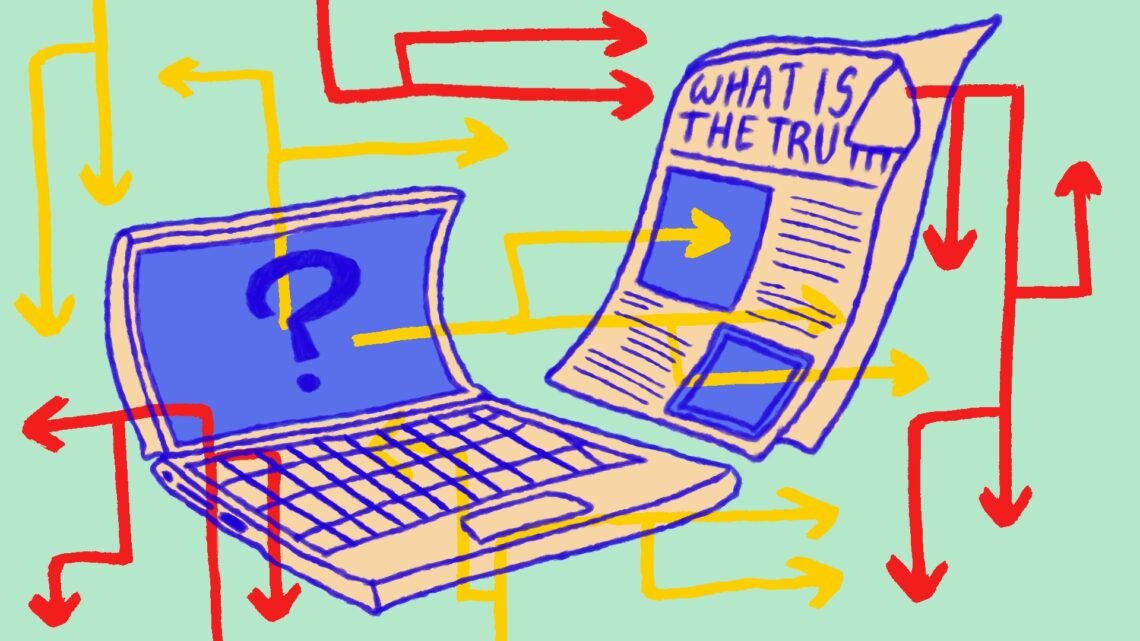
Ten years from the moment considered to ignite an era of “post-truth” media and information, our political and cultural worlds feels all the more foggy and confusing. Incidences such as Brexit and the election of Donald Trump are considered by some cultural critics to have solidified “post-truth” as the planetary political condition, instigating a domino affect on domains of knowledge such as scientific fields and the media (Buscher, 2025, p. 255) However, it is of question whether 2016 was truly the moment when truth “ended”. Was there ever a universally present reality that has now been obscured and eroded? Or is the idea of “truth” itself something too difficult to grasp, in that its dissemination has always been intrinsically linked with power?
Philosophers such as Antonio Gramsci would make the argument that a truthful reality permeating our atmosphere has never been objective, as it has only been understood and quantified by the subjective efforts of the human race. This understanding is thus bounded by a “single unitary cultural system”, within which contradictions of subjectivities influence the formation of groups and ideologies (1987, p. 445) For Gramsci, materialism is profound and knowledge is “real” insofar as it relates to the tensions between these subjectivities as nodal points, which is consumed by that which it is possible for humans to know. Central to his work is the idea of cultural hegemony, a theory distinguishing the (cultural) “direction imposed on social life” by the dominant regime of power in order to assert and maintain said dominance. It can be thought of as a permeating force of covert output towards a population who in turn conceives of their cultural and social order as legitimate (Lears, 1985, p. 568-9).
Michel Foucault wrote similarly in regard to the directed conception of truth, through his analysis of the prevalence of “regimes” of truth. He defined the political economy of truth as being characterised as an object of consumption produced under the control of dominant apparatuses (such as through media and education), circulating through these and being incited productively to invoke legitimacy for political power (Gordon et al, 1980, p. 132). He describes power not solely as a force that restricts and subjugates, but as a “productive network” that traverses the social body, adapted and “individualized” (Gordon et al, 1980, 125).
This article attempts to locate the state of truth and reality in the area of what has been described as “Platform Capitalism” (Srnicek, 2017). This is the play between digital technology and capitalism, wherein the latter has turned to data as a way to reaffirm its hegemony (2017, p.5). In an arena with an “increasingly immaterial” labour process, knowledge becomes the source of value. Platforms situate themselves between the user and their activity, which turning this into data which can be used to generate engagement. While Srnicek distinguishes between data and knowledge, some consideration is given here to the potential interchangeability in the terms that users engage with digital content.
As early as 1993 anthropologists such as Arturo Escobar have noted a necessity for recognition of the political economy of cyberculture, regarding its presence in cultivating a ‘regime of truth and power’ (in Buscher, 2025, p. 254). Today, new media scholars argue that the distinction between the on and offline is no longer relevant (in Buscher, 2024, p. 87). This suggests that these two spheres are so enmeshed that cyberspace is a place you can go to like any other. If this is the case, what we experience digitally is as much a part of our life-worlds as the smell of smoke or the sensation of hunger. Unlike these sensations, however, it can be harder to decipher the meanings behind the relentless signs encountered online. These lie outside of physicality but may subconsciously influence our understanding of what has happened, is happening and can happen, just like instincts innate or cultivated through lived experiences.
Anthropologist Martin Holbraad proposes an “infinitive” conceptualization of truth, due to the “alterity in terms of ontological difference” which cannot be holistically absorbed by one objective meaning (2012). The sleekness of cyberspace in its presentation of data as fact poses a threat to this. Not least in big platform methodology of per capita customization. This feels a far more nefarious flavor of alterity than the considered approach of subjective experiences, as algorithmic customization is motivated by promoting continued engagement. Bender et al, writing for the Association of Computing Machinery, note that the training datasets for Large Language Models (LLMs) overrepresent hegemonic viewpoint, thus “encoding” biases that dismiss counter-hegemonic perspectives (2021, p. 613-4). LLMs, trained by prediction tasks, are the advanced artificial intelligence algorithms that (re)produce human language.
Under the guise of objective data-fact dissemination, platforms actively promote content to individuals that will hold their attention, so that they stay there and leave more data behind. This bogus reification of data is reminiscent of the Marxian notion of capital generation, a point noted by Byung-Chul Han. He states that this state is the furthering of capitalism’s “necropolis”, a life without death in an “antiseptic space” due to the accumulation of wealth which can live on past the individual (2021, p. 9). This is reminiscent of Karl Marx’s “estranged being” which hoards an untouchable wealth in exchange for an alienated life (1844, XIV: 35 ). Han extends the necropolis of capitalism, using its fetish for machinery in “dataism”, in which the “vacuum” or blind spots of information and knowledge can always be plugged with more data to create a smooth and consumable picture. If it generates engagement, it doesn’t matter if there is a reflection of some empirical ‘truth’. Even more worrying is the candid comment of Bill Gates as referenced by Armin Rosen’s article on the tech giants’ legal exemption in Kenya. When asked if there was a difference between truth and data, he stated, “No, not really.” (Rosen, 2025)
What is the distinction? Srnicek outlines data as the information that something happened, and knowledge as that regarding why it happened (2017: 18). In this understanding, the gaping hole of contextual, experience understanding is left wide open, ready to be filled with “statistics on steroids” (Joque in Buscher, 2025, p. 260). Contradictorily, Antoinette Rouvroy defines algorithmic data productions as “knowledge without truth”, due to the combination of knowledges shared on platforms with algorithmic rationalities – which of course can appear as intuitively produced (2013). This distinction feels more fitting by acknowledging that this type of information can be a valid production of knowledge, yet distinguishing it as a truth is far more slippery. Truth feels like a far more nebulous concept to define and claim than knowledge, for which one does not need to relate to or experience to accept as present in another. As Srnicek emphasizes, data must also be arranged in clean, standardized formats in order to be useful, raising further questions regarding the removal of information charged with knowledge in order to be consumable and portable (2017: 19)
Knowledge-filled or truthful, the form of content of data circulating platforms is almost completely irrelevant. What matters is how it can be used in order to negotiate power and control. This is achieved by processes of linkage and connection. The more that data platforms can access and record, the more they can find patterns in our activity. One company that excels at linking databases is Palantir, which has been hired by states such as the case of the United Kingdom’s health system, the NHS. This perhaps sounds benign until we consider the relationship between various state databases. For example, in the Netherlands, municipalities can request healthcare data from practitioners (which usually occurs in ‘at risk’ areas e.g. racialized and low-income communities) in order to commit pre-emptive surveillance on individuals who might commit a crime. (Hielkema, 2022). While discrimination on ethnic bases is no new threat in the world of policing, the implementation of automated process of surveillance works to legitimize this process by “techwashing”. Fieldwork by sociologist Sarah Brayne among law enforcement in the United States discovered reliance on data-driven policing aided by software provided by Palantir in order to techwash racially biased investigative work (in Hvistendahl, 2021)
If the digital is no longer ‘another’ sphere, what is it now? A reflection of our world? Or do we co-create both spheres in symbiosis? If this is the case, is that a democratic process, or does the circulation and use of data as outlined present a clear hint to the dynamics of power in “platform capitalism”? The smooth claim of the very nature of such technology, with buzzwords such as ‘efficient’ and ‘transparent’ presenting a false mirror of objectivity works to impose a flattening of perspectives, reinforcing a face-value digital ontology as the reality of the individual is enmeshed with their algorithmic persuasion. Anthropologist Nick Seaver describes these algorithms as ‘unstable multiples’, as our feeds become a homunculus of all that ignites our libidinal energy, motivating engagement (2017). This endless self-fulfillment and confirmation bias is worrying enough at the individual level. If it helps to camouflage the production of a new regime of knowledge that enshrouds old forms of suppression, this forecasts a darker future at a collective level.
Perhaps it is not an ending of truth, a post-truth, but an ending to the regime of imposition of a truth that the masses must ascribe to – not in favor of complex multiplicities, but instead a promotion of designer truths, encased in the safety of polarities which need not be challenged. At this level, we may all enjoy truth as we see it, without having to worry about clashes of ontological understanding. As our comfortable and conceivable realities are funneled back to us, platform capitalism may continue to mutate in ways that transgress our detection, fulfilling some ultimate hegemonic process of truth modification and manufacturing.
References:
Büscher, B. (2024). Toward a planetary ethnography? From “frictions” to “tensions” in understanding post-truth capitalist power. Focaal, 100, 83–96.
Büscher, B. (2025). Artificial intelligence, platform capitalist power, and the impact of the crisis of truth on ethnography. Annual Review of Anthropology, 54. https://doi.org/10.1146/annurev-anthro-071323-113942
Escobar, A. (1993). The limits of reflexivity: Politics in anthropology’s post–“writing culture” era. Journal of Anthropological Research, 49(4), 377–391.
Foucault, M. (1980). Power/knowledge: Selected interviews and other writings, 1972–1977 (C. Gordon, Ed.). Pantheon Books.
Gramsci, A. (1987). Selections from the prison notebooks of Antonio Gramsci (Q. Hoare & G. Nowell Smith, Eds. & Trans.). International Publishers.
Han, B.-C. (2021). Capitalism and the death drive. Polity Press.
Hielkema, D. (2022, November). Kritiek op Eberhard van der Laan’s Top 400: Moeders weten nog steeds niet waarom hun zonen op die lijst staan. De Parool. https://www.parool.nl/idfa/kritiek-op-eberhard-van-der-laans-top-400-moeders-weten-nog-steeds-niet-waarom-hun-zonen-op-die-lijst-staan~bbe2f06a/
Hvistendahl, M. (2021, January 30). The LAPD used Palantir to predict crime. Now the program is being shuttered. The Intercept. https://theintercept.com/2021/01/30/lapd-palantir-data-driven-policing/
Rosen, A. (2019). Unnatural immunity. Tablet Magazine. https://www.tabletmag.com/feature/bill-gates-kenya-armin-rosen
Rouvroy, A. (2013). Algorithmic governmentality and the ends of critique. Query: Network Cultures. https://networkcultures.org/query/2013/11/13/algorithmic-governmentality-and-the-ends-of-critique-antoinette-rouvroy/
Seaver, N. (2017). Algorithms as culture: Some tactics for the ethnography of algorithmic systems. Big Data & Society, 4(2). https://doi.org/10.1177/2053951717738104
Srnicek, N. (2017). Platform capitalism. Polity Press.

Molly O’Toole is an Anthropology student at the UvA, with a Bachelor’s degree in Sociology and Social Policy from University College Dublin, Ireland. Disillusionment with the structures of power that dominate the way we communicate and organise ourselves motivated her to pursue an ethnographic approach to research and knowledge-cultivation. As a writing editor, counter-narratives, movement of people and ideas, nation-building and belonging, diasporic cultural reproduction and imagination influence her research interests. Aside from these, the important currents in her life are experimental music, photography, yoga and spending time among those who believe another world is possible <3

Célia Mortureux is a second-year Communication Science Bachelor student, at the University of Amsterdam. She has a vivid passion for painting and music, always striving to learn more. She loves to play around with many mediums, like photography, digital illustration, and traditional model drawing. She can often be spotted sketching in cafes or parks on a sunny day with an overpriced oat chai latte. She is also politically engaged, particularly in ocean protection advocacy.
You can follow her works at @doodling_un