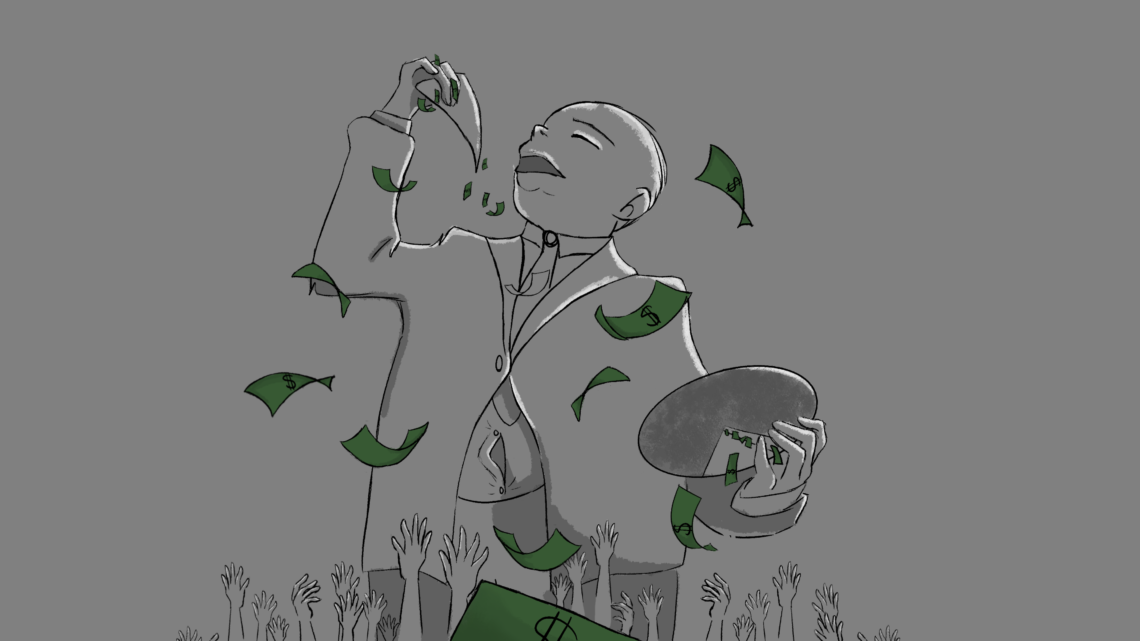
The Ending of the End: Capitalist Realism in Shambles
Mark Fisher was a cultural critic and theorist, who drew inspiration from Deleuze and Guattari (Seaton, 2021). The concept which he is most famous for is capitalist realism, which captures both the sense that capitalism is the only viable political and economic system, and the impossibility of imagining an alternative beyond it (Fisher, 2009). From this cultural-theoretical and philosophical perspective, capitalist realism derives its power from the very nature of capitalism: an all-consuming, all-subsuming assignment of a monetary value (Fisher, 2009). In this sense, capitalist realism is the ending of thought, the ending of alternatives, the ending of imagination, and the ending of the future. However, in today’s world, as the contradictions of capitalism become more obvious, it becomes harder to believe that capitalist realism is the only alternative. It becomes harder to believe that the future and alternatives end with capitalist realism. Therefore, it is a critical moment to ask: Are we nearing the end of capitalist realism? Are we reaching the ending of the end? To assess where the world stands via-à-vis capitalist realism, some of its key components must be explored.
Fisher (2009) views capitalism as profoundly transforming beliefs into aesthetics and engagement into spectatorship. In the end we are left with transfixed, idle spectators, who passively consume. Most importantly, capitalism promotes itself as a shield against the perils of the past and of belief, and as a ‘vaccine’ for fanaticism (Fisher, 2009). However, capitalism also produces a massive contradiction; it presents itself as the only possibility, the only alternative to tyranny, while it reproduces and entrenches it further. It permeates everything and produces a self-fulfilling prophecy of injustice and inequality. Drawing on political philosophy, Fisher (2009) quotes Badiou:
“a brutal state of affairs, profoundly inegalitarian – where all existence is evaluated in terms of money alone – is presented to us as ideal. To justify their conservatism, the partisans of the established order cannot really call it ideal or wonderful. So instead, they have decided to say that all the rest is horrible. Sure, they say, we may not live in a condition of perfect Goodness. But we’re lucky that we don’t live in a condition of Evil. Our democracy is not perfect. But it’s better than the bloody dictatorships. Capitalism is unjust. But it’s not criminal like Stalinism. We let millions of Africans die of AIDS, but we don’t make racist nationalist declarations like Milosevic. We kill Iraqis with our airplanes, but we don’t cut their throats with machetes like they do in Rwanda” (p. 8).
From a political science perspective, an embodiment of Badiou’s words is the War on Terror, when the capitalist-imperialist forces ravaged millions of peoples (and continue to do so today) to convince us that we do not live in a condition of evil, and that it is the only way forward. The War on Terror paved the way or the highly securitized, suffocating version of capitalism that exists today (Byler & Boe, 2020). The War on Terror created a perpetual crisis, consolidated the unimaginable end of ‘emergency’ measures, and further plunged us into believing that there is no alternative to capitalism (Kanji, 2021; Byler & Boe, 2020). Therefore, Fisher’s critical philosophical arguments can be observed in how cornerstone socio-political events have unfolded throughout recent history.
Moreover, Fisher’s perspective has many merits, and the all-encompassing nature of capitalism does permeate all facets of one’s life. However, since his book was published in 2009 a lot has changed. Are we nearing the end of the capitalist realist era? Obviously, this is not to say that things have changed for the better; rather, the opposite. Housing insecurity, the cost-of-living crisis, and employment precarity are rampant. In the Netherlands, in 2025 there was a shortage of approximately 395,000 homes and around half of Gen Z and Millennials are living paycheck to paycheck (NL Times, 2026; Deloitte, 2025). In these crises, capitalist accumulation by dispossession processes are central.
Marxist geographer Harvey (2004) explains these processes as capitalist policies resulting in centralization of wealth via the extraction of value from entities and people, are heavily reflected in today’s crises. Accumulation by dispossession further enhanced by the contemporary subscription culture, whereby access-based consumption is becoming prevalent (Angelova & Henck, 2024). People are further alienated from owning things, as when they subscribe for a service or good the ownership rights rest with the company (Angelova & Henck, 2024). The pockets of the wealthy are lined at an exponential rate, and these companies can increasingly invest in genocide, ethnic cleansing, securitization (Sheline, 2025). A lot of people even point to there being no ethical consumption under capitalism. Even buying food from the supermarket involves multiple overlapping and problematic political dimensions. And let’s not even delve into social media, one of late-stage capitalism’s best friends! All this to say that all facets of everyday life are deeply entwined with the mechanisms of capitalism.
However, these contradictions of capitalism are increasingly more visible, and people are becoming increasingly disillusioned by the state of affairs and desperate about the future, especially the youth. Of course, this disillusionment often leads to scapegoating the most vulnerable, rather than attacking the most powerful, who declare themselves our protectors and guides. However, we are also seeing many people standing next to migrants, women, LGBTQI+ people, and rejecting capitalist oppression. Are we nearing the end of the capitalist realist era? It is safe to say that people are becoming more fed up, and it is becoming even more difficult to defend capitalist realism as the best possible option for humanity. As the planet slowly burns and climate change ravages, it becomes impossible to believe that this is our optimal future.
It is impossible to say that humanity’s only future is to destroy itself and its home, that there is no alternative and that in the end, only a few hundred rich people will live on; it becomes increasingly harder to believe a lie. One of the central reasons for the discontent and disbelief with the current system, is the genocide in Palestine. For many people it has become hard to believe the selling point of capitalism, that we are better than the bloody dictatorships, as the heads of the system arm, fund, and benefit from a livestreamed genocide. It is hard to believe the better option when, for over two years, people constantly consume unimaginable pain and violence through your phone screen.
Are we nearing the end of the capitalist realist era? Over the last year massive protests have been erupting across the world, with people demanding a more just future, and in response being met with mass violence. At this time, we are seeing the teeth of American capitalist-imperialism: Gaza portrayed as a beachside resort, kidnapping a foreign head of state, threats of invasion, encouragements of oil and gas explorations, ICE kidnapping and killing human beings. It is exactly because the cracks of capitalist realism are becoming increasingly visible that we are seeing these teeth now. Trump is only the poster child of a wider system which degrades, humiliates, and exhausts most of humanity. He is only the face of quashing dissent and discouraging thought and action towards an alternative.
Are we nearing the end of the capitalist realist era? The answer is not straight forward, but alternative futures and pathways are increasingly gaining traction globally. For example, many different people are familiarizing themselves with Buen Vivir, a cosmovision based on Andean Indigenous ways of knowing. It stands in stark contrast to Western dominant philosophies and epistemologies (Gudynas, 2011). Buen Vivir negates fundamental principles of capitalism: growth, arbitrary linear timelines, progress, exploitation of nature (Gudynas, 2011; van Norren & Laats, 2022). It centers all people and the environment equally and strives for wellbeing, respect, and collaboration (Gudynas, 2011; van Norren & Laats, 2022). Further, Buen Vivir could be an ending for capitalist realism and a new beginning for thinking about the world and humanity in terms of care and mutual aid.
Are we nearing the end of the capitalist realist era? The one thing that is sure is that the walls are closing in, the contradictions are becoming more visible, and it is becoming harder to defend this system of oppression.
Are we nearing the end of the capitalist realist era?
References:
Angelova, M., & Henck, I. (2024). Beyond ownership: A critical discourse analysis of subscription model (de)legitimation. (Master’s thesis, Stockholm University, Sweden). Retrieved from
https://www.divaportal.org/smash/record.jsf?pid=diva2%3A1891752&dswid=4672
Byler, D., & Boe, C. S. (2020). Tech-enabled ‘terror capitalism’ is spreading worldwide. The surveillance regimes must be stopped. The Guardian.
Deloitte. (2025, 14 May). Deloitte Gen Z & Millennial survey: Concerns about the cost of living have increased significantly. Retrieved from
https://www.deloitte.com/nl/en/about/press-room/deloitte-genz-and-millennial-survey.html
Fisher, M. (2009). Capitalist realism: Is there no alternative? New Alresford, UK: Zer0 Books.
Gudynas, E. (2011). Buen Vivir: Today’s tomorrow. Society for International Development, 54(4), 441-447.
Harvey, D. (2004). The new imperialism: Accumulation by dispossession. Socialist Register, 40, 63-87.
Kanji, A. (2021). War on Terror: Legal colonialism reincarnated. Al Jazeera.
NL Times. (2026, 24 January). Dutch housing supply to rise, but shortage expected to persist through 2027. Retrieved from
https://nltimes.nl/2026/01/24/dutch-housing-supply-rise-shortage-expected-persist-2027
Seaton, L. (2021, 20 January). The ghosts of Mark Fisher. The New Statesman.
Sheline, A. (2025). Who profits? US corporations and the whitewashing of Israel’s genocide in Gaza. Arab Center Washington DC.
Van Norren, D. & Laats, H. (2022). The concept of biodiversity conservation viewed through philosophies of the Global South: Andean Buen Vivir, African Ubuntu and Buddhist Happiness. Biodiversity Online Journal, 2(2), 1-12.


Taylor Brunnschweiler is a third year studying European Languages and cultures at the University of Groningen. Other than languages, she enjoys cosmetology, illustration and graphic design in general.