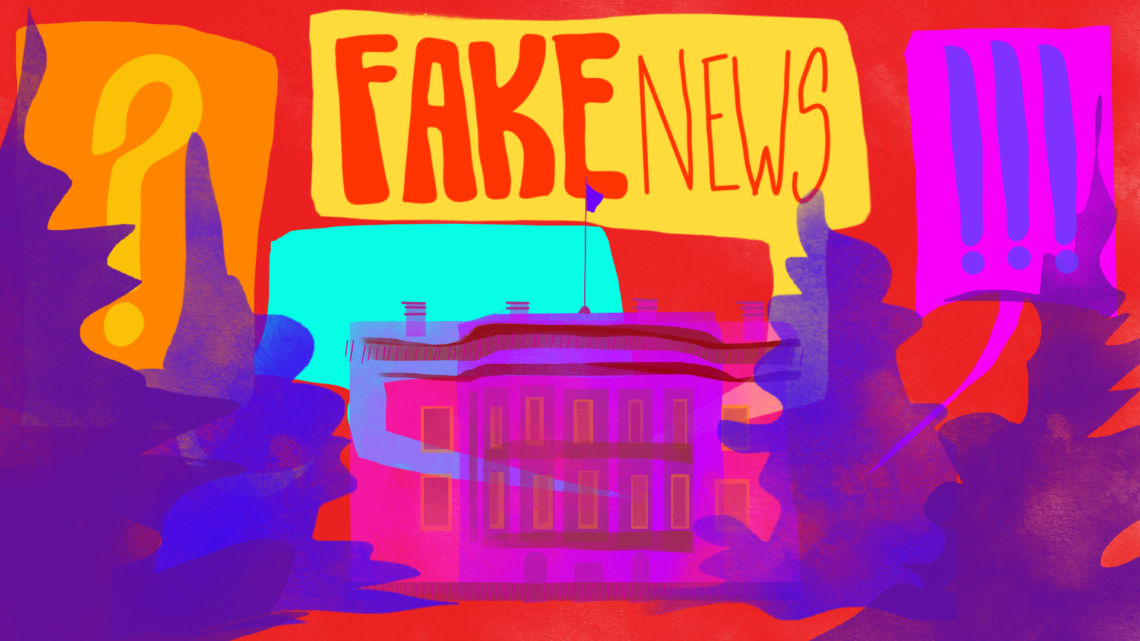
Has the line between truth and falsehood been blurred? The 21st century post-truth society
Word of the year!
In 2016, the word “post-truth” won Oxford English Dictionary’s word of the year, defeating such prominent opponents as “alt-right”, “chatbot”, or “woke” in order to claim the honourable title (Oxford Languages, 2016). And this success should not really be of surprise to anyone if they care to remind themselves of the arguably two most significant political events that took place that year, namely, the Brexit referendum and the US presidential elections won by Donald Trump. The former was notorious for the wide use of misinformation and false claims on both sides of the vote (Khan, 2018), while during the latter, according to research, fake news stories have been clicked on and read through 760 million times – about three stories per American adult (Allcott & Gentzkow, 2017). To the mix add a spoonful of the Cambridge Analytica scandal, spice it with a 2000% increase in the usage of the word “post-truth” (BBC, 2016), cook for just about two minutes over light heat while stirring, and voilà! You have your Word-of-the-Year winner. Serve it hot and remember to pour it over with a fake-news-disinformation-filter-bubble brew for a little more texture… On a more serious note, though, post-truth society and politics might be one of the greatest issues that we currently face as a society, and one which should definitely not be swept aside. They are real, and they can hurt.
Do we fear the truth?
According to the OED definition, “post-truth” is: “relating to or denoting circumstances in which objective facts are less influential in shaping public opinion than appeals to emotion and personal belief” (Oxford Languages, 2016). The first use of the term in that context – that is, the socio-political one – can be traced back to a Serbian-American playwright Steve Tesich (the term possesses a broad philosophical dimension to it as well, which is a topic for a whole another article, and while these two sometimes overlap, the focus here is kept mainly on the former). In his 1992 essay for the Nation magazine, referring to the Iran-Contra affair and the Persian Gulf war, Tesich famously wrote: “we, as a free people, have freely decided that we want to live in some post-truth world” (Tesich, 1992). In this article entitled “A Government Of Lies,” Tesich, taking inspiration from the notion of Vietnam syndrome, and drawing upon the infamous Watergate scandal, coined what he called the Watergate syndrome. Whereas the former was about the public’s resentment towards the US military “interventions” abroad due to the big fiasco of the Vietnam War, the latter is about its growing indifference towards truth. A kind of fatigue with the many blows inflicted far and wide upon the rotting phantom of American righteousness.
The constant besmearing of their nation’s noble and pure conscience so tiring, that the poor citizens cannot take it anymore and need to resort to convenient lies eagerly supplied by their government, or, as Tesich puts it, “we began to shy away from the truth. We came to equate truth with bad news and we didn’t want bad news anymore […]. We looked to our government to protect us from the truth” (Tesich, 1992). For Tesich, this changing social character, ushered in by Watergate, cleared the decks for what, in his, view were “far more serious and un-American [offences] than the crimes for which Nixon was kicked out of office,” (Tesich, 1992) namely Reagan’s Iran-Contra affair, and Bush’s Persian Gulf war – arguably post-truth society’s two most important milestones. Although back in 1992 Tesich’s article did not make a splash, his little creature was now set free for the world to see and it slowly started to gain momentum and popularity, and draw the attention of other authors, commentators, and scholars. Needless to say that the growing number of instances of post-truth politics, with the Iraq War being the brightest example of them all, was of invaluable help.
“Politicians have always lied”
Reading the definition or hearing someone talk about post-truth society or politics, one might ask the question of why did the phrase seem to have garnered such buzz and flurry in recent years? After all, politicians have been lying for as long as political institutions exist. Is it not yet another one of these catchy, bloated phrases thrown and tucked left and right by the self-proclaimed intellectuals, that only litters our everyday language? Should its miserable life not be cut short by Ockham’s razor? It seems that the answer could not be clearer – by no means does post-truth appear to be an unnecessary phrase, quite the contrary. It is an utterly revealing concept describing a peculiar and specific condition eating our society up from the inside, in a fashion unique to the modern day and age.
In essence, all of the criticism waged against the concept is some variation of and comfortably takes refuge under the aforementioned “umbrella notion” that lies have been the inherent feature of politics since the very beginning, and thus the current talk of post-truth is not very revealing. However, it could be argued that this seems to be a claim that could only be articulated by someone with a fundamental misunderstanding of the concept, as it utterly oversimplifies the issue. The core of the problem is not founded upon the act or the idea of lying itself, but rather the dwindling of the line between falsehood and truth, and the constant confusion brought about by the inability to distinguish between the two. As a result, people become numb and indifferent towards truth (as argued in Tesich’s article) – and that is where the real and new danger lies. As it has been aptly summarised in the 2016 article from The Economist, “The term picks out the heart of what is new: that truth is not falsified, or contested, but of secondary importance.” (The Economist, 2016) It can also be seen in a short story a political satirist Matthew Norman shared in the pages of The Independent on the day of Trump’s first win: “[…] A few weeks ago, when a friend repeated the old canard about Hillary being terminally ill, I prissily pointed out that this was simply not objectively true. ‘I don’t give toss about objective truth’ he said with what might serve as the heraldic motto for the age. ‘Everyone’s free to choose their own truth.’” (The Independent, 2016)
To make a distinction between a lie and a post-truth state, it might be useful to bring in what the Korean philosopher Byung-Chul Han, a very keen critic of our current society and its culture, wrote about in his recent book titled “Infocracy: Digitization and the Crisis of Democracy.” (Han, 2022) There, Han, inspired by his observations of the information society, expands on the concept of “new-nihilism” (which he has been developing over the course of his previous few works). Han aptly points to the fact that lying is paradoxical in its nature. A lie’s goal is to obstruct truth, yet simultaneously it is what reaffirms it. Anyone who lies knowingly must recognize the truth, for the lie to be possible in the first place. The more insistingly one lies, the more truth is confirmed. The liar is not a nihilist; truth is indeed the object of their offence, however, crucially, they do not question the idea of truth itself. A lie is only possible when the distinction between truth and falsehood is intact (Han, 2022). And that line is precisely what the post-truth society has breached and blurred. Fake news are not lies precisely, they attack “facticity” itself, in effect “de-factising” the reality. When Trump carelessly says that immigrants in the US are eating cats and dogs (Thomas & Wendling, 2024); when Bush or Blair proclaim that Saddam Hussein possesses weapons of mass destruction; when LePen quotes fanciful numbers of immigrants allegedly entering France every day (Melo, 2016), they are not all liars in a classical sense, knowingly distorting truth and reality. They are rather indifferent to facts; they do not care about the truth, focused on achieving whatever political aim they have in mind. And in that sense, they are nihilists.
How did we get here?
With all that said, what were the specific conditions and factors that contributed most significantly to the emergence of post-truth society and politics? The leading argument among the more MCS-oriented [1] academics, and one which is, arguably, especially effective in countering the criticism of post-truth’s uniqueness, is based on our recent technological progress. The technology in question being, obviously, the Internet, which has enabled and facilitated the exchange of information beyond our wildest dreams, and which, to be frank, might be credited with kickstarting (along with postmodernists) the post-truth era. More recently, of course, it was specifically social media that became the main driver and the most prominent actor. These technological revelations led to the emergence of a few crucial pillars of a post-truth society.
There is the omnipresent information and opinion overload. We are now allowed access to an endless array of media outlets with just a few clicks, everyone with a connection to the Internet has been given a voice, and the pressure to have an opinion on everything has become prevalent. Countless magazines, blogs, Instagram accounts, group chats, personal websites, YouTube videos etc. unfurled a rough sea of competing truth claims for us to try to stay afloat on and not drown (not even mentioning trying to swim it). Meanwhile, the time which we are able to devote to consuming and then crucially evaluating and reflecting upon all of this information, news, and opinions stayed fixed, if not diminished. We have no time to assess them, so we are simply forced to accept them due to convenience.
Furthermore, there is a collapse of shared authorities arbitrating truth. Traditional journalism, which until now has worked as a gatekeeper of public truth claims, is now in a big crisis, having found so many competing, equally loud, if not louder, voices around it (almost exclusively under the guise of social media). In order to compete with their heavily emotional, clickbait-y nature, traditional journalism has become more reliant on easy emotions and cognitive biases. On top of that, trust in governmental institutions is in constant decline (Valgarðsson, 2025).
Then there is the resultant of the prior condition – the news fatigue. A concept very much resembling Tesich’s Watergate syndrome. With sensational and dramatic news having a monopoly on headlines, with one crisis after another reported in the media, people get depleted by the news; they grow tired and numb, and as a kind of defence mechanism, they anesthetise themselves to falsehood. Moreover, the algorithms that overrun, curate, and personalize the feed for every social media user are of no help. Faithful servants to the attention economy, trying to keep the users on the app for as long as possible, thereby not offering them any content that might, heaven forbid, challenge their opinions or views. In turn, we have filter bubbles and echo chambers, which let us all comfortably wallow in the jacuzzis of our unquestioned, unchallenged, only righteous beliefs. These algorithms are the absolute antithesis of one of the most important aspects of a well-functioning democracy, that is, pluralism.
Lastly, there is the elephant in the room – the influence of 20th-century post-modernist thought, which to some scholars might be of even greater importance than the Internet in shaping our current post-truth society (Keyes, 2024; McIntyre, 2018). For them, post-modernism laid a very solid groundwork for what the Internet only then amplified. And obviously, for over half a century now, post-modernism has been everyone’s favourite whipping boy, but its critique by the academics via the lens of its contributions to the post-truth society unfortunately has some merit. Post-modernism really did rock the foundations of truth, maybe even dethroning it, with its relativist, subjectivity-based rhetoric. Its encouragement towards having one’s own truth with claims like “there is no position outside our own particulars from which to establish universal truth” (Calcutt, 2016) or “anyone’s opinions and beliefs are valid as anybody’s else” (Glichrist, 2018), it might have very likely strengthened the populist ideologies and helped us transition to the post-truth society of today.
While it may well have equipped today’s right-wing demagogues with the arms they are currently using (cf. climate change denialism), it must be noted that, assumedly, it was a primarily left-leaning (if not far-left) school of thought that sought to question the predominating political, cultural, and social status quo. With thinkers like Foucault, Latour, or Derrida not necessarily trying to question the notion of truth as a whole, but rather the one, the only correct, the allegedly objective truth, which they perceived as an institutionally fabricated means of social control and oppression. From this perspective, theirs was a philosophy of emancipation, freedom, and individualism rather than populism, anti-scientific theory, and nihilism. Nevertheless, no matter how good the intentions were, it might be effectively argued that they contributed to the latter. The damage has been done.
One more, fairly recent and original contribution to the discussion about post-truth comes from a Belgian philosopher, Simon Truwant, who, in his recent book, speaks of the idea of truth-pluralism (Truwant, 2025). Truwant objects to the popular criticism of the post-truth society, saying that people living it simply disregard truth. In his book, he very aptly points to the fact that even the wildest conspiracy theorists are committed (one might argue that even more so than a regular person) to truth – to their kind of truth. For him, ours is the world of many truths which exist simultaneously and meddle. Truwant distinguishes four of them: empirical truth – verifiable in the real world, e.g. Riga is Latvia’s capital (correspondence theory of truth); ideological – where individual’s values form a coherent web of beliefs (coherence theory of truth); pragmatic truth – set of assumptions that shape and frame the way in which you go about having discussions; finally, the existential truth – beliefs we are deeply committed to, not empirical, very subjective, our “own truths”. Truwant does not put the blame on the number of truths that are out there, which he perceives as a natural human condition, but rather us overlooking this very condition, and thus, while speaking, debating, and arguing with each other, not signalling as we transition between them. If that is the case for Truwant, it is like the conversation never happened. It was not broadcast on the same frequency. Two ships passed off each other in the middle of the night, both sailing their own way, never making contact (Overthink Podcast, 2025). The problem is not the number of truths; the problem is our lack of truth-literacy, our incompetence in lucidly emphasizing as we move between different kinds of truth in our conversations.
What now?
So yes, unfortunately, we do live in a post-truth society – to repeat a sentiment from the beginning: post-truth can hurt, and it did hurt, there are countless examples, and unfortunately, likely many more to come. What can we do with it then? How do we get rid of this terrible affliction? How do we outgrow numbness, and how do we sensitise ourselves to truth once again? How do we redraw the line between truth and falsehood, and how do we bring it back to focus?
There are a few answers to these questions, amongst which likely the simplest is simultaneously the strongest (Ockham strikes again) – we become aware of the issue, the rest will follow. Hopefully, this newly obtained awareness makes us more responsive and sensitive about the news we read, videos we share, or the facts that we ourselves bring into our collective information table. Hopefully, we become better at distinguishing between different truths and more fluent at signalling when we jump between them. Maybe we do not so quickly devolve into name-calling in our disputes and arguments; instead, we discard some of that pathos (not all, though), filling the void with a bit more logos. Maybe we help the rise of truth’s stock by creating a renewed demand for it. Lastly, and maybe most importantly, one may hope that we hold our leaders and institutions accountable, we point out instances of their disregard for truth, denounce it, and denude it. We push our decision-makers, who in turn pressurize the untouchable techno-giants to change and moderate their algorithms, which are a crucial turbine of the post-truth jet, which, hopefully, crashes and explodes sooner rather than later.
[1] – abbr. Media and Communication Sciences
References:
Allcott, H., & Gentzkow, M. (2017). Social media and fake news in the 2016 election. Journal of Economic Perspectives, 31(2), 211–236. https://doi.org/10.1257/jep.31.2.211
BBC. (2016, November 16). ‘Post-truth’ declared word of the year by Oxford Dictionaries. BBC News. https://www.bbc.com/news/uk-37995600
Calcutt, A. (2016). The truth about post-truth politics. Newsweek. https://www.newsweek.com/truth-post-truth-politics-donald-trump-liberals-tony-blair-523198
Gilchrist, A. D. (2018). Post-truth: An outline review of the issues and what is being done to combat it. Ibersid: Revista de Sistemas de Información y Documentación, 12(2), 13–24. https://doi.org/10.54886/ibersid.v12i2.4601
Han, B.-C. (2022). Infocracy. Polity Press.
Khan, S. (2018, July 28). Final Say: The misinformation that was told about Brexit during and after the referendum. The Independent. https://www.independent.co.uk/news/uk/politics/final-say-brexit-referendum-lies-boris-johnson-leave-campaign-remain-a8466751.html
Keyes, R. (2004). The post-truth era. St. Martin’s Press.
McIntyre, L. (2018). Post-truth (pp. 1–15). MIT Press.
Melo, S. (2016). Marine Le Pen is “Liar of the Year”. POLITICO. https://www.politico.eu/article/marine-le-pen-is-liar-of-the-year-french-national-front
Oxford Languages. (2016). Oxford word of the year 2016. OUP. https://languages.oup.com/word-of-the-year/2016
Overthink Podcast. (2025). Post-truth. YouTube. https://youtu.be/7ti-3M04eW4?si=YYVkM6HS6AC_zkNy
Tesich, S. (1992, January). A government of lies. The Nation, 13. https://www.thefreelibrary.com/A+government+of+lies.-a011665982
The Economist. (2016). Art of the lie. https://www.economist.com/leaders/2016/09/10/art-of-the-lie
The Independent. (2016). We’ve entered a post-truth world and there’s no going back. https://www.independent.co.uk/voices/us-election-2016-donald-trump-hillary-clinton-who-wins-post-truth-world-no-going-back-a7404826.html
Thomas, M., & Wendling, M. (2024). Donald Trump repeats baseless claim about Haitian immigrants eating cats and dogs in Springfield, Ohio. BBC News. https://www.bbc.com/news/articles/c77l28myezko
Truwant, S. (2025). De waarheid heeft vier gezichten. Houtekiet.
Valgarðsson, V., et al. (2025). A crisis of political trust? Global trends in institutional trust from 1958 to 2019. British Journal of Political Science, 55, e15. https://doi.org/10.1017/S0007123424000498

Paweł Fligier is a 2nd year Philosophy student at Jagiellonian University and 1st degree student at the Cracovian Jazz School in the class of electric guitar. Philosophy-wise most interested in Critical Theory and Philosophy of Politics. Consumes hazardous amounts of culture. Number one Jack Kerouac stan. Somewhere probably watching a western. Wastes all of his free time. Rarely will pick up a guitar and record it.

Célia Mortureux is a second-year Communication Science Bachelor student, at the University of Amsterdam. She has a vivid passion for painting and music, always striving to learn more. She loves to play around with many mediums, like photography, digital illustration, and traditional model drawing. She can often be spotted sketching in cafes or parks on a sunny day with an overpriced oat chai latte. She is also politically engaged, particularly in ocean protection advocacy.
You can follow her works at @doodling_un