The Nearest Little Aliens: Soil Organisms
While humans are busy looking up in the sky to find other extraterrestrials on other planets, one look down is all it would take to find an entire new world awaiting our discovery. Soil organisms live in the soil and are usually not seen by most of us, which may also seem to be aliens to people because of their invisibility. But those little alien-like creatures have a significant impact on biogeochemical cycles, and consequently, the climate.
The organisms living in the soil are different and various, from fungi to snails, and from cyanobacteria to nematodes. One classification for them is based on their sizes, namely microflora (e.g. bacteria), microfauna (e.g. protozoa), mesofauna (e.g. small arthropods) and macrofauna (e.g. earthworms) (Blume et al., 2016). They can also be classified by other attributes, for instance, their function in biology and ecology. The one thing they have in common is that they help with decomposition in the soil organic matter cycling.
But before we dive into those amazing aliens who live closest to us, there is a fundamental question to be asked: why is there soil? How does the soil, where those organisms live, come to be? The latest emerging and widely accepted explanation comes in the form of the soil continuum model (Lehmann & Kleber, 2015).
In the soil continuum model, organic matter exists as a spectrum of organic fragments that are continuously processed towards smaller molecular size. Molecular structure does not control long-term decomposition of soil organic matter. The model focuses on the ability of decomposer organisms to access soil organic matter and on the protection of organic matter from decomposition provided by soil minerals and soil aggregates (Lehmann & Kleber, 2015; Schmidt et al., 2011). That means, in principle, soil organic matter would be decomposed by soil (micro)organisms given the appropriate conditions and sufficient time, but the matter is distributed on the spectrum of different decomposition phases, and because of the protection from soil minerals and aggregates, soil comes into the place where soil is.
As there might (potentially) be endless species and variations under the umbrella term extraterrestrial aliens, so are the soil organisms. In this article, two cases would be discussed to provide a closer look at how they live, how they interact, and how they impact.
Those little aliens know how to use their own talents to trade for food. The example for this would be mutualism between legumes and nitrogen-fixing bacteria. Nitrogen fixation is the process that changes nitrogen gas into ammonia, which can be used by living organisms. This process is mediated in nature only by N-fixing rhizobia bacteria. In legumes and a few other plants, the bacteria live in nodules, which are the small growths on the roots. Within these nodules, nitrogen fixation is done by the bacteria (Flynn & Idowu, 2015; Sørensen & Sessitsch, 2007). The plant gives space for those bacteria to live and provides carbohydrates to them; in return, the ammonia they produce is taken up by the plant.
Not only do they have the tricks to get nutrients for themselves, but they also play a very important role at a global scale. Those little aliens’ strong impact can be found in the positive feedback loop of Arctic greening, which is essentially the advance of the treeline in the Arctic zone, turning tussock tundra to shrub tundra, then to woodland, and finally to forest (Wilmking et al., 2006). While this is still in debate in academia, it is widely accepted that the tree line advance can cause a positive feedback loop to global warming (e.g., Parker et al., 2015; Wilmking et al., 2006; Zhang et al., 2013). It seems counterintuitive at first sight because with more trees it should be beneficial to mitigate global warming. The behind-the-scenes reason has something to do with soil organisms.
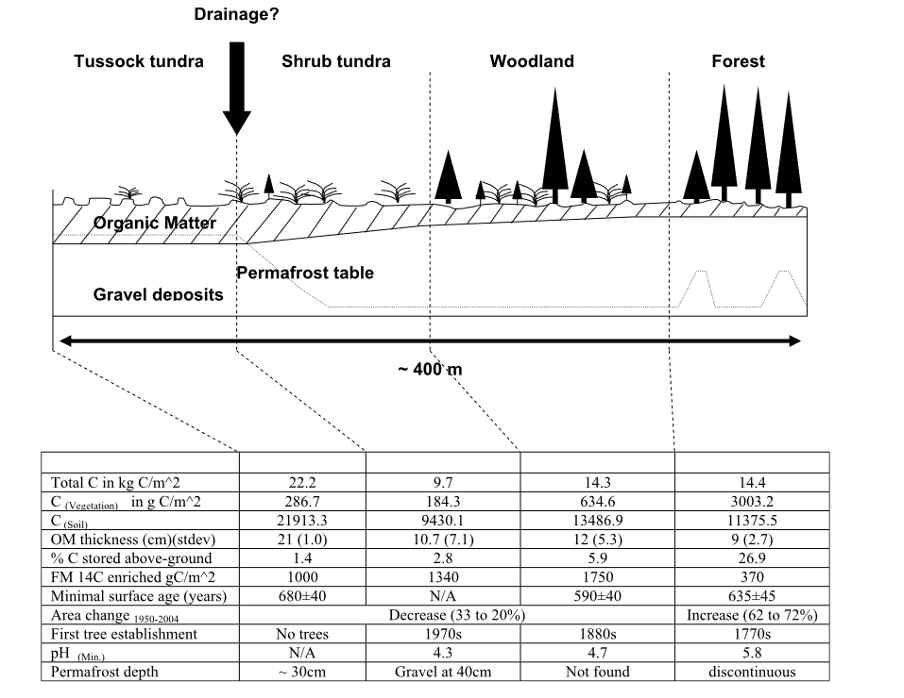
As shown in Figure 1, from tussock tundra to forest, soil organisms’ activities would be dramatically activated, and their respiration would be reinforced. The carbon in the soil from ca. 21913 g/square meter (tussock tundra) to 11376 g/square meter (forest), outweighing the increased carbon storage from the aboveground plant, leading to a decrease in total carbon. A study in Sweden also showed a similar pattern. Their conclusions suggest the expansion of deciduous shrubs onto Arctic soils with large stores of C could result in loss of carbon to the atmosphere, and they hypothesised that the mechanism for the loss is a shift from ericoid to ectomycorrhizal systems which happens at the same time as the vegetation changes (Parker et al., 2015). Although the soil organisms seem to exist quietly, obscurely, or even alienly, they play a profoundly important role in the environment and climate.
Since the attached high importance of soil organisms, have any policies being proposed or launched regarding them? The answer is yes.
In 2015, the 4 per mille, or 4 per 1000, was launched at the COP21 (21st Conference of the Parties to the United Nations Framework Convention on Climate Change) in Paris (Minasny et al., 2017). This program aims to increase global soil organic matter stocks by 0.4% annually to help offset the global anthropogenic greenhouse gas emissions. Soil organisms play an important role in turning litter into soil carbon stocks as decomposers. It is very important to focus on agriculture land use, because the stock depends mainly on land-use patterns, and there is a rapid decrease in carbon stocks in cultivated soils due to generally lower carbon inputs and faster organic matter mineralisation rates by soil organisms (Dignac et al., 2017). Common practices to increase soil carbon stocks involve changes in farming, such as no-till and crop rotation, which help make soil and soil fauna healthier and eventually offset emissions.
With the ambitious program, more people are becoming aware of soil organisms within scientific and policymaking communities, recognizing that, thanks to those creatures, biogeochemical cycles can be realized, and our climate goals can be achieved (if they are happy).
However, among the broader public, attention to those soil organisms remains limited and insufficient. It seems that some animals are more visible than bacteria and fungi when the public talks about environmental protection. Soil organisms still sound like a more niche and specialized group compared to rescuing a whale in the Aegean Sea. This is not to diminish the importance of the latter, but the public should also be more aware of those ubiquitous, diverse, and indispensable creatures. This phenomenon does reflect an underrepresentation and invisibility of soil organisms’ group, and it calls eagerly for people’s recognition. While policies indeed are beneficial and pivotal from a top-down perspective, greater public engagement would help to ensure that soil organisms are more recognized, and their importance is more pronounced.
Calling them the nearest little aliens might create a sense of distance and isolation. More importantly, however, it offers an opportunity to acknowledge their existence and appreciate their hard work, which many people may not immediately think of while talking about ecology and climate change, which would ultimately impact the life of every resident on Earth.
Next time you enjoy a picnic sitting on the grass in a park, remember to say hi to those nearest little aliens living beneath our feet, because while you are basking in the sun, they are working arduously, for you, for me, and for everyone.
References:
Blume, H.-P., Brümmer, G. W., Fleige, H., Horn, R., Kandeler, E., Kögel-Knabner, I., Kretzschmar, R., Stahr, K., & Wilke, B.-M. (2016). Soil Organisms and Their Habitat. In H.-P. Blume, G. W. Brümmer, H. Fleige, R. Horn, E. Kandeler, I. Kögel-Knabner, R. Kretzschmar, K. Stahr, & B.-M. Wilke, Scheffer/SchachtschabelSoil Science (pp. 87–122). Springer Berlin Heidelberg. https://doi.org/10.1007/978-3-642-30942-7_4
Dignac, M.-F., Derrien, D., Barré, P., Barot, S., Cécillon, L., Chenu, C., Chevallier, T., Freschet, G. T., Garnier, P., Guenet, B., Hedde, M., Klumpp, K., Lashermes, G., Maron, P.-A., Nunan, N., Roumet, C., & Basile-Doelsch, I. (2017). Increasing soil carbon storage: Mechanisms, effects of agricultural practices and proxies. A review. Agronomy for Sustainable Development, 37(2), 14. https://doi.org/10.1007/s13593-017-0421-2
Flynn, R. R., & Idowu, J. (2015). Nitrogen Fixation by Legumes. https://pubs.nmsu.edu/_a/A129/
Lehmann, J., & Kleber, M. (2015). The contentious nature of soil organic matter. Nature, 528(7580), 60–68. https://doi.org/10.1038/nature16069
Minasny, B., Malone, B. P., McBratney, A. B., Angers, D. A., Arrouays, D., Chambers, A., Chaplot, V., Chen, Z.-S., Cheng, K., Das, B. S., Field, D. J., Gimona, A., Hedley, C. B., Hong, S. Y., Mandal, B., Marchant, B. P., Martin, M., McConkey, B. G., Mulder, V. L., … Winowiecki, L. (2017). Soil carbon 4 per mille. Geoderma, 292, 59–86. https://doi.org/10.1016/j.geoderma.2017.01.002
Parker, T. C., Subke, J., & Wookey, P. A. (2015). Rapid carbon turnover beneath shrub and tree vegetation is associated with low soil carbon stocks at a subarctic treeline. Global Change Biology, 21(5), 2070–2081. https://doi.org/10.1111/gcb.12793
Schmidt, M. W. I., Torn, M. S., Abiven, S., Dittmar, T., Guggenberger, G., Janssens, I. A., Kleber, M., Kögel-Knabner, I., Lehmann, J., Manning, D. A. C., Nannipieri, P., Rasse, D. P., Weiner, S., & Trumbore, S. E. (2011). Persistence of soil organic matter as an ecosystem property. Nature, 478(7367), 49–56. https://doi.org/10.1038/nature10386
Sørensen, J., & Sessitsch, A. (2007). Plant-associated bacteria lifestyle and molecular interactions. In J. D. van Elsas, J. T. Trevors, J. K. Jansson, & P. Nannipieri (Eds.), Modern soil microbiology (2nd ed., pp. 211–236). CRC Press. https://doi.org/10.1201/9781420015201-13
Wilmking, M., Harden, J., & Tape, K. (2006). Effect of tree line advance on carbon storage in NW Alaska. Journal of Geophysical Research: Biogeosciences, 111(G2). https://doi.org/10.1029/2005JG000074
Zhang, W., Miller, P. A., Smith, B., Wania, R., Koenigk, T., & Döscher, R. (2013). Tundra shrubification and tree-line advance amplify arctic climate warming: Results from an individual-based dynamic vegetation model. Environmental Research Letters, 8(3), 034023. https://doi.org/10.1088/1748-9326/8/3/034023

Weichen Zhang is a first-year master’s student in Earth Sciences at the University of Amsterdam. He really likes nature and touching some grass, maybe that’s why he chose this major. In his spare time, he enjoys a variety of activities, including cooking, listening to music, staying active, sketching, and of course, writing. He believes writing is a form of creation, through which he builds a deeper connection between the world and himself.

Zofia Jankowska is a third year Product Design student at the Bydgoszcz University of Science and Technology. In her studies she’s most interested in furniture and graphic design – creating labels and packagings. Zofia enjoys everything creative: photography, drawing her own characters, sewing clothes, making jewelery or colorful makeup.
You can find her projects at @zjankowska.design