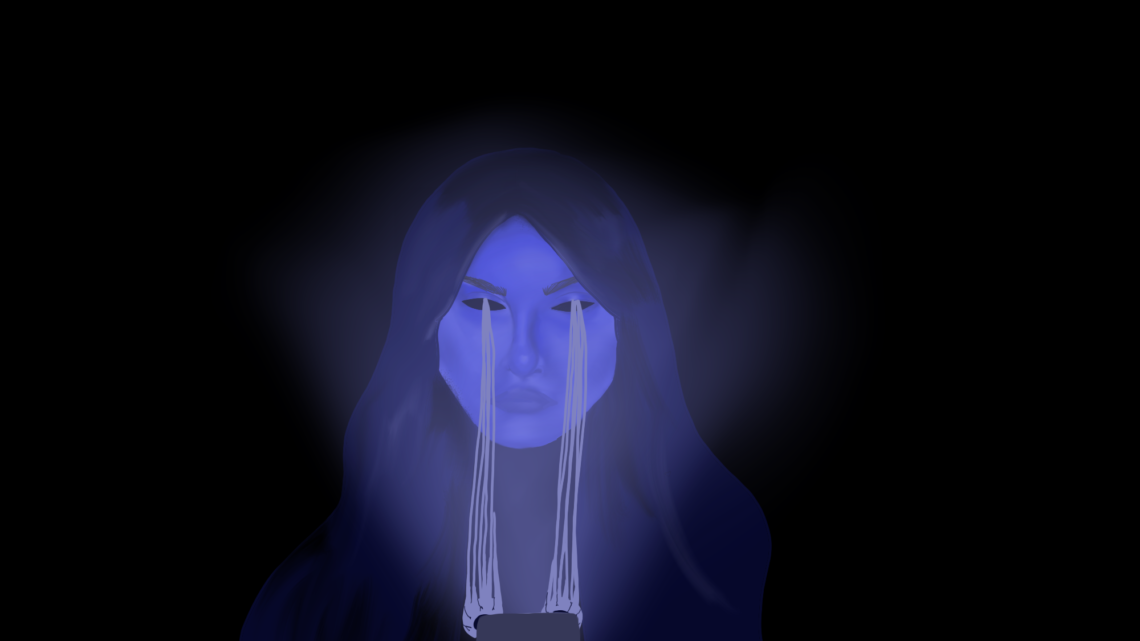
New Era, Infinite Notifs, and Reshaped Senses
The other day, seven in the evening, I was on my way back home, only to realize I forgot my charger at school. It should not have a lasting influence because I am going back to campus within twenty-four hours, but I was anxious the whole way. I kept questioning how this little liquid crystal was able to manipulate one’s life and that it should not affect me per se. But it seems that the internet has become part of my senses in the digitalized world. In fact, many people have experienced similar feelings as well.
After the world’s first general-purpose computer was invented in 1946 (Brockmeier, 2021), the so-called analytical engine is now far more than just analytical. It has become the liquid crystal in people’s grips, an extension of our body and mind. It seems that we have ultimate access to unlimited knowledge, and we have the easiest way to get information about what is happening at every corner around the globe. Finally, it is the time when we are the closest to being omniscient, with the internet and our devices, also with the assistance from social media. However, the phenomenon of overloading extensive information can be harmful to people.
One harmful impact on people is the feeling of FoMO (Fear of Missing Out). FoMO can take many forms, but in general, it expresses the fear of not being able to follow other people’s latest life updates. FoMO is very common with the widespread use of smartphones with internet functions and social media platforms. People who experience FoMO mostly look to social media to reduce their fear, and vice versa; for instance, for some people, when they stop using Instagram, their FoMO appears to be higher (Akbari et al., 2021; Tanhan et al., 2022). This is a positive feedback loop, but not the good kind: People use social media, and they might experience FoMO. When people get off social media, their FoMO levels appear to increase. To reduce the elevated FoMO feelings they have, they tend to get back on social media again.
FoMO has a negative impact on life satisfaction. A study on 323 undergraduates in Turkey found that there is a significant negative correlation between FoMO and satisfaction with life, which means an individual’s life satisfaction decreases when their FoMO level increases (Deniz, 2021). The irony of FoMO is that even though people are actively participating or experiencing what is happening in the moment, it robs people of real experiences because they constantly obsess over what could be done at the same time (Bisping, 2018). Also, unintentionally (or intentionally) being part of the game to trigger other’s FoMO feelings, people tend to focus more on how their online profiles appear to be than how they experience real life. Those above-mentioned factors contribute to the sense of detachment between individuals and their real life, leading to reduced life satisfaction for them.
Apart from the harmful psychological effects that information overload can have on people, it can also create negative impacts on people’s senses from a media and communication perspective.
The unprecedentedly unlimited access to information seems to be a total freedom, which, to some extent, it indeed liberates the width of horizons, but it also builds an intangible wall to imprison our senses, and contrastingly, our senses become less free.
With one being able to access unlimited and endless information in theory, the amount of information one perceives is still not infinite in practice since no one has unlimited time and energy. Nowadays, the information we perceive is largely dependent on who we are or how we show preference, for instance, the recommendation algorithm based on our browsing history. As a result, the information we receive would rather limit our horizon instead of broadening it. The echo chamber effect can explain why this happens.
Echo chambers are the environments where the opinions or beliefs about certain topics get reinforced because of sources with similar tendencies or repeated interactions with peers. With the effect of echo chambers, an existing opinion could be reinforced, and the entire group with the opinion could be shifted towards even more extreme positions over time. Echo chambers exist in different forms of online media, including blogs, forums, and social media sites (Cinelli et al., 2021). Additionally, they are also amplified by AI use, because of algorithms prioritizing engagement over factual accuracy, and this may even lead to or worsen political polarisation, misinformation, and social fragmentation (Goswami, 2025). The emergence of echo chambers comes into place to offer some ease and comfort to people who get lost and are flooded with information, but at the same time, this artificial island in the ocean of information essentially can also be a prison to the senses.
Another challenge appears to be related to people’s hurriedness. Pointed out by Subramanian (2018), the real question is, “are we allowing enough time at the receiving or sending end to complete or comprehend a message”, with an overstimulated mind in a digital era where the communication and data transfer are on their highway. When people need to perform and adjust faster with the “flashing messages across continents and among younger and adventurous people”, they tend to act in haste and hurry to complete tasks. For our minds, we always need time to build connections to certain topics and get the essential sense of them. But with undue haste, it becomes more difficult for our senses to reach somewhere. Or even, after all these (seemingly) information feasts, they are still halting, not going anywhere.
To mitigate the effects of excessive information, some people opt for an idyllic lifestyle. For instance, Jamie Bisping (2018) satirically remarked, “Throw away your phone, or gizmo if you will, buy a Nokia brick and move to a farm to live as an Amish recluse. Worked for me. Sent from my carrier pigeon.” While this might not be the most feasible solution for many people who live in concrete jungles, it can still be beneficial for the senses if they take a break from consuming information insatiably and stay away from information sources from time to time.
I still remember that night when I restricted my phone use because I forgot my charger. My mind had extra peace, and my senses became sharper, until my roommate came home and handed me his.
References:
Akbari, M., Seydavi, M., Palmieri, S., Mansueto, G., Caselli, G., & Spada, M. M. (2021). Fear of missing out (FoMO) and internet use: A comprehensive systematic review and meta-analysis. Journal of Behavioral Addictions, 10(4), 879–900. https://doi.org/10.1556/2006.2021.00083
Bisping, J. (2018, February 19). FOMO, No-Mo: How to get over the fear of missing out. University of Cambridge. https://archive.thetab.com/uk/cambridge/2018/02/19/fomo-no-mo-how-to-get-over-the-fear-of-missing-out-107208
Brockmeier, E. K. (2021). The world’s first general purpose computer turns 75. Penn Today. https://penntoday.upenn.edu/news/worlds-first-general-purpose-computer-turns-75
Cinelli, M., De Francisci Morales, G., Galeazzi, A., Quattrociocchi, W., & Starnini, M. (2021). The echo chamber effect on social media. Proceedings of the National Academy of Sciences, 118(9), e2023301118. https://doi.org/10.1073/pnas.2023301118
Deniz, M. (2021). Fear of missing out (FoMO) mediate relations between social self-efficacy and life satisfaction. Psicologia: Reflexão e Crítica, 34(1), 28. https://doi.org/10.1186/s41155-021-00193-w
Goswami, G. (2025). AI Echo Chambers: How Algorithms Shape Reality, Influence Democracy, and Fuel Misinformation. https://www.authorea.com/doi/full/10.36227/techrxiv.174059950.03385147?commit=874ec27e1203a6a72bc26f0a7af8ff78f7dd4ee0
Subramanian, K. (2018). Myth and Mystery of Shrinking Attention Span. 5, 1–6. https://www.researchgate.net/publication/327367023_Myth_and_Mystery_of_Shrinking_Attention_Span
Tanhan, F., Özok, H. İ., & Tayiz, V. (2022). Fear of missing out (FoMO): A current review. Psikiyatride Guncel Yaklasimlar, 14(1), 74–85. https://doi.org/10.18863/pgy.942431

Weichen Zhang is a first-year master’s student in Earth Sciences at the University of Amsterdam. He really likes nature and touching some grass, maybe that’s why he chose this major. In his spare time, he enjoys a variety of activities, including cooking, listening to music, staying active, sketching, and of course, writing. He believes writing is a form of creation, through which he builds a deeper connection between the world and himself.

Helena Nascimento is a Brazilian student journalist studying Communication Science at the UvA. She has always been passionate about art, which led her to becoming an illustrator for Inter.