The Senses at the Edge of Ecstasy: Would Friedrich Nietzsche Have Loved Rave Culture?
In the dark, industrial cathedral, your pulse is no longer your own. It is surrendered to a relentless 145 BPM. As the light slices reality into irregular frames, your body dissolves into the crowd, and the “I” is liquidated in a sweat-soaked mirage of strangers. Welcome to the Dionysian rave – would Nietzsche approve?
In The Birth of Tragedy (1872), Nietzsche presents a tension at the core of art and human experience. He saw the world divided between the Apollonian dream of order and the Dionysian storm of chaos. The Apollonian embodies the god of light and harmony. It is the architect of order, reason, and the crystalline structures of the mind. This is the force that keeps you grounded, the steady hand that carves the world into clear shapes and keeps the individual “I” intact. But behind this surface of logic lies the Dionysian, the ancient power of wine, dance, and celebration. This rhythm penetrates into your bloodstream, hitting you until your “I” breaks and you are forced back into the wild and nameless mass (Nietzsche, 1872/2010).
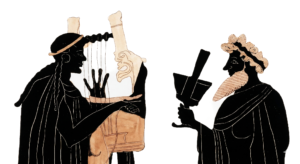
Ancient Greek tragedies, Nietzsche argued, were born when the Apollonian and Dionysian collided, creating a kind of controlled chaos (Nietzsche, 1872/2010). The Apollonian gave the story its shape. The lines of dialogue, the structure of the stage, the costumes and masks, all guided the audience and helped them follow what was happening. It was the part that kept people grounded, the thread they could hold on to. The Dionysian was the force that moved through them. The chorus sang and danced, drums thundered, wine flowed, and excitement vibrated in the air. The audience felt it in their bodies, in their hearts, in their breath. They laughed, they cried, they trembled together (Nietzsche, 1872/2010).
The story gave them a frame, but the energy around them carried them beyond it. For a few hours, the individual sense of self softened. People became part of something larger, something alive, something almost uncontrollable. The Apollonian shaped the experience, but the Dionysian made it unforgettable. In that moment, art was not just watched or thought about. It was felt. The audience experienced what Nietzsche saw as the heart of tragedy: a world where reason and instinct, structure and chaos, self and collective life collided in a way that transformed them (Nietzsche, 1872/2010).

Today, the same tension pulses in the heart of a modern rave. The festival itself with the line-up, the lights, and the timed music is Apollonian, a frame that guides the night. But the moment the bass drops, the Dionysian takes over. The sound shakes your chest, the lights cut the dark into jagged shapes, and the crowd moves as one body. You forget yourself. Sweat mixes with the heat of other bodies, the beat becomes your heartbeat, and your arms and legs move without thinking. Time and space blur. Every glance, every movement, every scream joins the rhythm, and for a few hours, you are both nothing and everything.
This dissolution of the individual is a necessary rebellion against the very foundations of our culture. Nietzsche was the first to realise that modern civilisation is, in fact, a project aimed at suppressing the Dionysian principle. It began with Socrates, whom Nietzsche called “Theoretical Man” (Nietzsche, 1872/2010). Socrates made a fatal revolution: he declared that life should be understood and subordinated to reason, turning instinct into a “mistake” and the body into a simple obstacle to logic (Nietzsche, 1872/2010).
Today, this Socratic spirit has reached its absolute peak. Modern life has turned us into heads in a Zoom call. Floating brains carried by bodies we barely notice. We see it in a corporate culture that demands the total quantification of existence. Every hour is segmented into “deliverables” and every human interaction is filtered through the cold lens of “efficiency.” We live by the tyranny of the digital calendar, subordinating our natural rhythms to the relentless logic of the 24/7 market. Even our senses are managed through “professionalism.” This is a polished mask designed to hide the messy reality of being human.
Sociologically, this represents the peak of modern disembodiment (Leder, 1990). We have become “subjects” who exist only as data and discourse (Foucault, 1995/1975). Modernity forces a split between the mind and the flesh, turning us into observers of our own lives. We are no longer present in our bodies.
But the rave offers a violent exit from this digital cage. It isn’t just a party. It’s a biological intervention. It is the return of life through sound. Here, the sub-bass does not act as music, but as an instrument of ego suppression. Research confirms that very low frequencies (VLFs) directly stimulate the vestibular and tactile systems, increasing dance intensity by 11.8% even when sound is not audibly recognised (Cameron et al., 2022).
This statistics reveals that the body is smarter than the mind. It proves that even when our conscious, rational brain is unaware of the stimulus, our muscles and nerves already respond to the truth of the rhythm. The pulse bypasses our logic entirely. It shows that beneath the layers of “subjectivity” and social conditioning, we remain primal beings. The body reclaims its authority without asking for permission from the ego. This process causes temporary hypofrontality, a condition in which the prefrontal cortex of the brain, responsible for logic and self-awareness, shuts down under the pressure of sensory overload (Cameron et al., 2022). It hits like a force that moves every part of you. It shakes your chest, your stomach, your legs. It makes your muscles dance even when you do not choose to. The rational part of the brain, the inner Apollonian, quietly gives way under the weight of vibration and sensation.
To understand this sensual return, we must turn to Nietzsche’s concept of “Rausch” (Nietzsche, 1872/2010). Although this is often translated from German simply as “intoxication,” for Nietzsche, “Rausch” represents a profound physiological shift, a state of heightened strength in which the body’s internal energy overwhelms it. He believed that art and self-affirmation were impossible without this festive outburst of feelings (Nietzsche, 1872/2010).
What drives this collapse is the tension between the two primary forces. Nietzsche defines the Apollonian beginning as the “principium individuationis,” or the principle of individuation (Nietzsche, 1872/2010). It is a force that creates the illusion of a separate “I,” wrapping us in a veil of logic and form so that we feel like unique, isolated beings. This is the mask we wear in the “civilised world.” But under the pressure of the Dionysian storm, this desire for boundaries is eventually disrupted (Nietzsche, 1872/2010).
The music acts as the final blow, pushing this tension into the state of “Rausch.” Here, the principle of individuation finally collapses, breaking the curse of the isolated self. As the prefrontal cortex of the brain dims and low frequencies take over, the Apollonian mask of the “civilised individual” falls off. When logic fades into rhythm, the dancer is no longer observing the world from a distance. The dancer becomes the world.
In the storm of sound, of flashing lights and moving bodies, there is no escape from life. There is only life in all its intensity, its terror, and its wonder. Every ache, every fear, every heartbeat transforms into pure energy and joy. This state of “total fun” is Nietzsche’s only way to overcome the tragic emptiness of existence (Nietzsche, 1872/2010). We dive into this collective storm not to forget ourselves, but to embrace life in all its frightening fullness through self-forgetfulness. In this dedication, every suffering transforms into pure and unfiltered energy of delight.
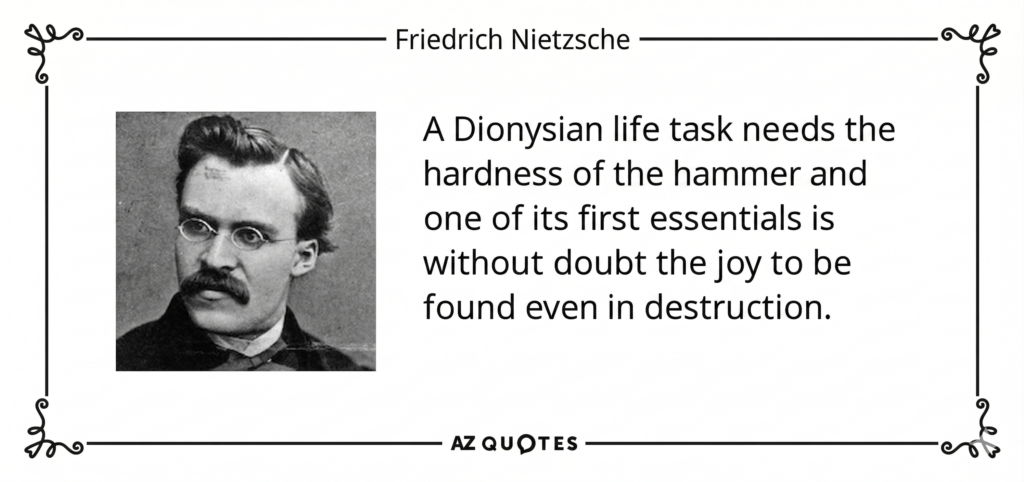
By surrendering to the pulse of the crowd, the modern reveler crosses a threshold where philosophy meets physiology. Nietzsche would recognise more than a mere party in such a sonic ritual. He would see a vital act of rebellion against a sterile, overly rationalised world. In the industrial cathedral of the dance floor, we revive the Dionysian fire that modern life attempts to extinguish. We finally stop being “floating brains.” We return to the primal wisdom of the body and the raw authority of our senses.
This is where the digital abstraction ends and the physical truth begins. Here, we gain a collective strength that no Zoom call or bureaucratic schedule could ever offer. By surrendering to the “Rausch,” we do not merely survive the chaos of existence. We celebrate it. We stop thinking about life and start feeling its terrifying beauty. The beat goes on, and in this persistent rhythm, we find the courage to say “Yes” to life as it is. It is loud, it is messy, and through our awakened senses, it is stunningly alive.
References
Cameron, D. J., Dotov, D., Flaten, E., Bosnyak, D., Hove, M. J., & Trainor, L. J. (2022). Undetectable very-low frequency sound increases dancing at a live concert. Current Biology, 32(21), R1222–R1223. https://www.sciencedirect.com/science/article/pii/S0960982222015354
Foucault, M. (1995). Discipline and Punish: The Birth of the Prison (A. Sheridan, Trans.). Pantheon Books. (Original work published 1975).
https://monoskop.org/images/4/43/Foucault_Michel_Discipline_and_Punish_The_Birth_of_the_Prison_1977_1995.pdf.
Leder, D. (1990). The Absent Body. University of Chicago Press.
https://installations2010.wordpress.com/wp-content/uploads/2010/09/theabsentbody.pdf.
Nietzsche, F. (2010). The Birth of Tragedy (W. Kaufmann, Trans.). Random House. (Original work published 1872).

Darya Aleinikava is a third year European Politics student at UvA. Having lived in Belarus and Spain before moving to Amsterdam, she developed a strong interest in memory politics, identity, and how history shapes political narratives. She speaks five languages and loves chess, photography, and getting lost in museums.
Madelene Nitzsche is a Cultural and Social Anthropology student at the University of Amsterdam with a background in communication studies, interior design, graphic design, and photography. Her experience growing up in Western and non-Western environments has influenced her interest in culture, art, urbanisation, and psychology. Opposing viewpoints, emotion, and contrast are a focus in her artistic work and it is also what drives her interest in the ethnographic approach. She is currently experimenting with multimedia artwork and poetry and perception of reality. Her vision is to integrate art and culture with ecology and community to improve societal relations and the relation to the self. You can follow her process @_.__.amber.___.
a fascinating read! love the blend of philosophy and modern culture. thank you for sharing this perspective.