Do Senses Make Sense?
Have you ever wondered whether the five commonly known senses truly describe our abilities to perceive the world? How is it that we can feel the temperature, even though we cannot smell, see, hear, taste, or directly touch it? And how is it even possible that we perceive anything at all? Our bodies are capable of far more than we realize. They detect and interpret signals in ways we rarely consider.
Let’s start simple: what are the senses? Most of us would say without any hesitation – sight, hearing, smell, touch, and taste. However, these seem insufficient when it comes to temperature. If none of these senses detect it directly, how do we feel it?
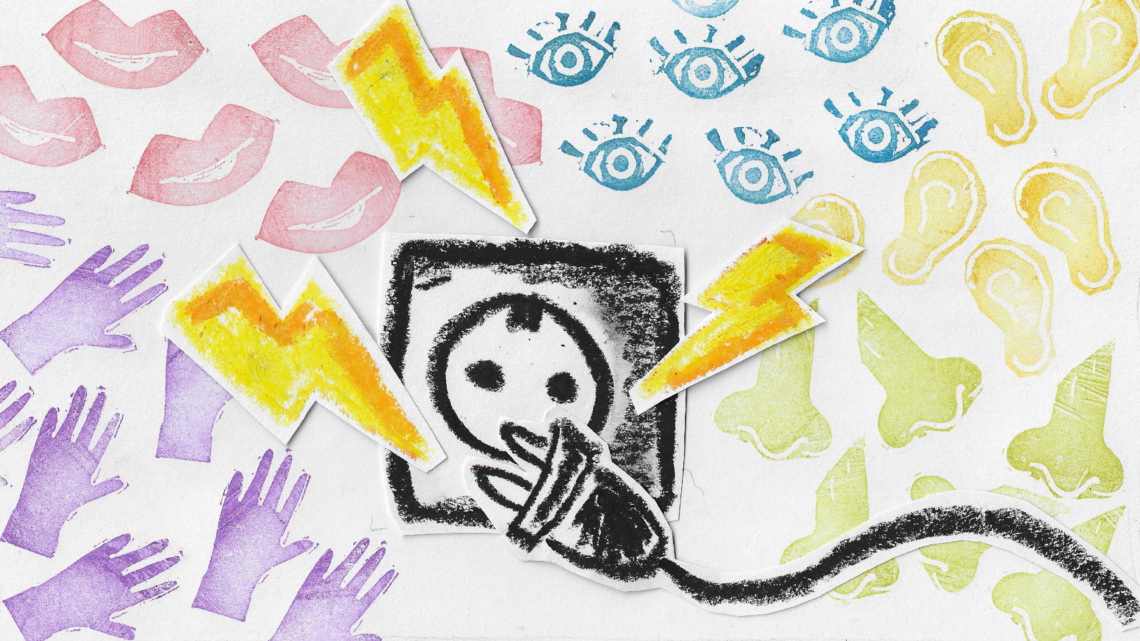
Biologically speaking, sensation is possible thanks to the receptors. Our bodies possess thousands upon thousands of receptors of many different classes and types. You can think of them like power sockets – European, British, Australian etc. All designed differently, but all serve the same purpose: allowing current to flow when the correct plug is inserted.
In biology, that “plug” is called a ligand – specific molecule that binds to a receptor. Taking smell as an example. The air contains tiny molecules responsible for different scents. When such molecules enter the nose, they bind to receptors, which transduce the signal and send it to our brain, allowing us to smell. Just like a plug fitting into the correct socket, a ligand binds to a specific receptor, triggering a signaling cascade that carries information forward.
Now, let’s have a closer look at taste. Our tongues are covered in thousands of taste buds composed of taste receptor cells. When we eat, the food is broken down into smaller particles which can be detected by these receptors – chemoreceptors, to be exact.
But how many flavors can we detect? The common answer is five: sweetness, sourness, saltiness, bitterness and umami. The last one might be unfamiliar to some, as it was only relatively recently accepted as a basic taste.
Umami (or savoriness) was first described in 1908 by Kikunae Ikeda. He isolated a substance (monosodium glutamate) which could not be described by any known tastes. This discovery led to further studies on taste perception and its chemistry, eventually resulting in the identification of specific receptors capable of detecting umami. It took nearly a hundred years for the scientific world to accept umami. Around that time, the initial Ikeda’s paper was translated into English from Japanese, making it accessible worldwide (Ikeda, 2002).
But what do those tastes actually mean? Why do they exist? Today, we usually know what we are eating – our ancestors did not and the taste provided crucial survival information. Different chemical components have different tastes and these signals helped guide dietary choices.
Bitterness would indicate toxins, combined with sourness could indicate spoiled food. Saltiness suggests presence of minerals. Sweetness – carbohydrates, an easy source of energy. And umami, associated with glutamate, may indicate proteins (Bachmanov & Beauchamp, 2007).
How does temperature fit into this picture? There are no “heat molecules” that could bind to a receptor, right? Here we encounter a different class of receptors – thermoreceptors. Those do not act as a socket – they do not have a traditional binding site. Instead, thermoreceptors are free nerve endings. You can think of them as cables which transmit the information from the ending deeper into the body and brain.
As you might expect, different areas of the body have different densities of thermoreceptors – face, lips, tongue, or hands being the densest. We also have two types of temperature receptors: those for cold and those for warmth. First located more superficial in the skin, while the second are typically found deeper. Interestingly, cold receptors can also be activated by temperatures above 45°C. This explains why extremely hot objects can produce a brief sensation of cold (Encyclopedia Britannica, 2022).
Another interesting phenomenon is that extremely cold objects, such as dry ice, do not primarily activate thermoreceptors but pain receptors – called nociceptors. This occurs because of ice crystal formation in the skin, causing tissue damage (Encyclopedia Britannica, 2022).
It is also important to note that touch and pain are detected by completely different types of receptors. Touch is mediated by low-threshold mechanoreceptors, which respond to even very light stimuli. In contrast, nociceptors have a high activation threshold and only stimuli strong enough to potentially cause damage will activate them. These stimuli can be thermal, mechanical, or chemical (Dubin & Patapoutian, 2010).
Speaking of things we “sense” without a dedicated sense, there are also sensations we believe we perceive – but in reality, we do not. You might wonder: what can we seemingly feel, yet are biologically unable to detect? The answer is something most would not expect: moisture.
Have you ever touched drying laundry and were not sure whether it was completely dry? Or thought it was dry, only to realize it still felt damp when you wore it? Now you know that your body simply cannot say if it’s still wet! The human body does not have specific receptors for detecting wetness. This sensation of moisture is constructed from a combination of touch and temperature – integrating input from both thermo- and mechano- receptors (Filingeri & Ackerley, 2017).
In contrast, some organisms do possess specialized receptors for humidity, known as hygroreceptors, found in insects such as cockroaches. Sensing the humidity is crucial for them, as they risk drying out, and for many insects, moisture is essential for reproduction, particularly for laying eggs (Filingeri, 2015).
This is just one example of the abilities other animals have that humans lack. There is much to say about these differences. Smell, for instance, is often underestimated in humans, but for dogs it is essential – and we actively make use of it. Dogs can be trained to locate truffles or, importantly, to track missing people. Another fascinating ability, which falls outside both hearing and seeing, is echolocation. Animals like whales and bats produce sounds and interpret the returning echoes. They then analyze factors like delay and intensity to detect objects.
Turning back to humans, we also have some unusual “superpowers” which other animals do not have – at least as far as we know. One such phenomenon is synesthesia, a unique trait experienced by some individuals. Returning to the electricity metaphors, it can be thought of as distinctive wiring in the brain – like a single switch turning on the light in two completely different rooms at the same time.
According to Grossenbacher and Lovelace (2001), synesthesia can be genuine (consistent throughout life), acquired, or drug-induced. There are also many different forms of synesthesia, involving variety of sense combinations. One of the most well-known forms is sound-color synesthesia, or chromesthesia. It is the ability to see colors while hearing sounds, experienced by individuals such as Cynthia Erivo – a British actress and singer best known for her recent role as Elphaba in Wicked. There are many more variations, reflecting different sensory combinations. Despite how fascinating it sounds, much about synesthesia remains unknown.
On the complete opposite side of synesthesia, where senses are combined, are people who have lost – or never had – some of the traditional senses. Removing even one sense would fundamentally change how we perceive the world. Many experienced a glimpse of this during the COVID pandemic, when infected individuals lost their smell and/or taste. Suddenly, the texture of food gained much more attention.
Art is an interesting case when it comes to senses. To fully appreciate a film, you need sight; to appreciate music, you need hearing. The inclusivity of many art forms is limited by the senses they rely on. Some museums have begun to address this by creating tactile models of paintings, allowing new group of visitors to experience them through touch. Adapting art to different sense is a challenge, and art that engages multiple senses at the same time is another form in itself.
As you can see, the range of sensation our body can detect extends far beyond the traditional senses, they do not come close to capturing this complexity. In the end, what we perceive is not simply a direct readout of surroundings, but an interpretation shaped by biology, context and the brain itself – making our perception profoundly fascinating. Our bodies are remarkable and capable of far more than we consciously realize.
References
Bachmanov, A. A., & Beauchamp, G. K. (2007). Taste receptor genes. Annual review of nutrition, 27, 389–414. https://doi.org/10.1146/annurev.nutr.26.061505.111329
Craig, A.D., Hensel, H., Rogers, K. (2022, February 7). thermoreception. Encyclopedia Britannica. https://www.britannica.com/science/thermoreception
Dubin, A. E., & Patapoutian, A. (2010). Nociceptors: the sensors of the pain pathway. The Journal of clinical investigation, 120(11), 3760–3772. https://doi.org/10.1172/JCI42843
Filingeri, D., & Ackerley, R. (2017). The biology of skin wetness perception and its implications in manual function and for reproducing complex somatosensory signals in neuroprosthetics. Journal of neurophysiology, 117(4), 1761–1775. https://doi.org/10.1152/jn.00883.2016
Grossenbacher, P. G., & Lovelace, C. T. (2001). Mechanisms of synesthesia: cognitive and physiological constraints. Trends in cognitive sciences, 5(1), 36–41. https://doi.org/10.1016/s1364-6613(00)01571-0
Ikeda, K. (1908). On a new seasoning, Journal of the Tokyo Chemical Society, 30, 820-836.
Ikeda, K. (2002). New seasonings. Chemical senses, 27(9), 847–849. https://doi.org/10.1093/chemse/27.9.847
Filingeri D. (2015). Humidity sensation, cockroaches, worms, and humans: are common sensory mechanisms for hygrosensation shared across species?. Journal of neurophysiology, 114(2), 763–767. https://doi.org/10.1152/jn.00730.2014

Norbert Borski is a first-year Master’s student in Biomedical Sciences with a specialization in Oncology at UvA. He completed his Bachelor’s in Biology in Cracow, Poland, and then traveled through South America before settling in Amsterdam. Besides spending time in the lab, he is passionate about exploring new cultures, traveling, and learning languages. In his free time, he enjoys creating art through pottery, painting, and writing, as well as appreciating art through film and theater.

Merel Hamminga is currently in her last year of the Master Clinical Neuropsychology at the University of Amsterdam. She did her bachelor in Psychobiology, but made the step towards Psychology because she thought she didn’t want to go in the scientific direction. In the end, she is no longer sure about that and would like to combine psychology and science in a future job.In her free time, she enjoys a good book, playing tennis and nature (especially birds). But most of all, she likes drawing,crafting or being creative.